Weak wearer channel
Preserve room audio, mark wearer attribution uncertain, ask for repositioning after the session—not during a high-stakes meeting.
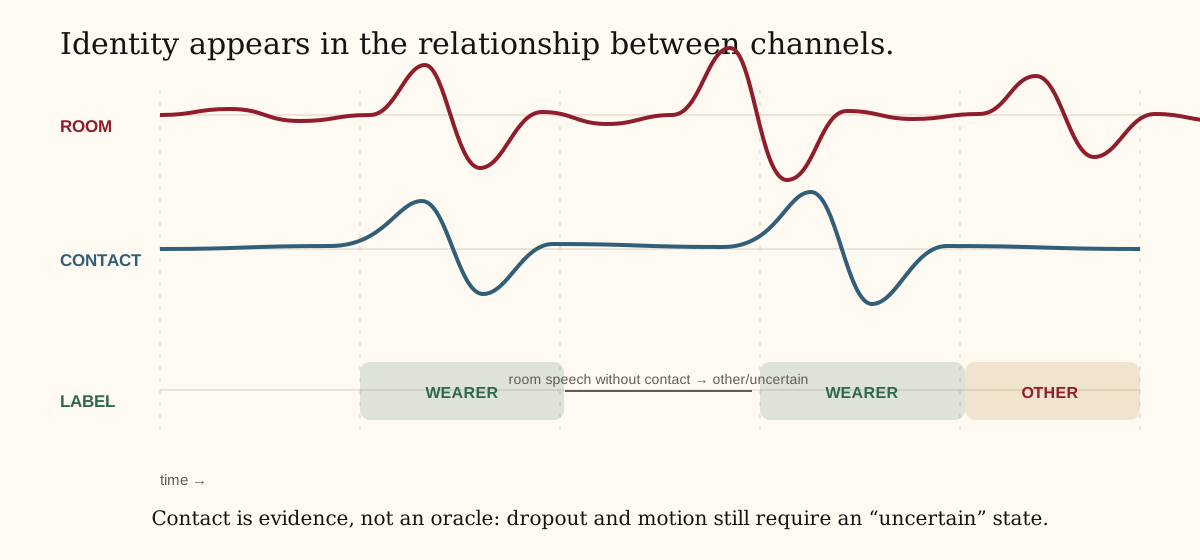
The wearer tag answers “when did I speak?” The reader’s room microphone answers “what happened in the room?” The product aligns them, preserves provenance, and lets the user control retention.
| Element | Contains | Must not contain |
|---|---|---|
| Choker/tag | Textile band, breakaway/mute, contact pad, passive sensor, resonator/antenna, enclosure | Battery, persistent storage, firmware, cloud credential, invisible software mute |
| Reader puck | RF source and receiver, room microphones, visible indicator, compute, local storage, secure element, USB/network interface | Undocumented capture path, shared factory password, mandatory cloud dependency |
| Host app | Session control, consent UX, transcript, export, delete, optional model endpoint | Capture-state ambiguity, undeletable raw audio, silent training reuse |
| State | RF | Room mic | Storage | User-visible truth |
|---|---|---|---|---|
| Muted | Reader idle; tag mechanically open/detuned | Off | None | Mute flag visible on choker; puck dark |
| Armed | Reader self-test only | Off | Health metrics only | Ready indication distinct from recording |
| Capturing | Approved illumination active | On | Encrypted session | Unmistakable indicator driven from capture path |
| Processing | Off unless session continues | Off | Local working set | Processing—not recording—shown separately |
| Exported/deleted | Off | Off | Per policy | Receipt identifies destination or deletion scope |
These are architecture requirements; numeric product targets remain provisional until P0–P2 establish distributions.
Session {
  session_id, started_at, ended_at, device_id,
  jurisdiction_profile, notice_confirmed,
  streams: [
    {kind: "room_raw", clock, calibration_id, hash},
    {kind: "contact_demod", clock, rf_profile, calibration_id, hash},
    {kind: "contact_restored", parent_hash, model_id, hash}
  ],
  segments: [{start, end, label, confidence, evidence}],
  exports: [{time, format, destination_class}],
  deletion: {requested_at, completed_at, scope}
}
The evidence field should distinguish contact coherence, acoustic diarization, and user correction. Never collapse all three into a mysterious confidence score.
Preserve room audio, mark wearer attribution uncertain, ask for repositioning after the session—not during a high-stakes meeting.
Record the gap explicitly. Do not hallucinate the wearer channel from the room channel.
Continue local encrypted capture if the user requested it. Queue optional remote processing.
If physical-state sensing and RF measurement disagree, fail closed: stop capture and surface a hardware fault.