P0 · Contact
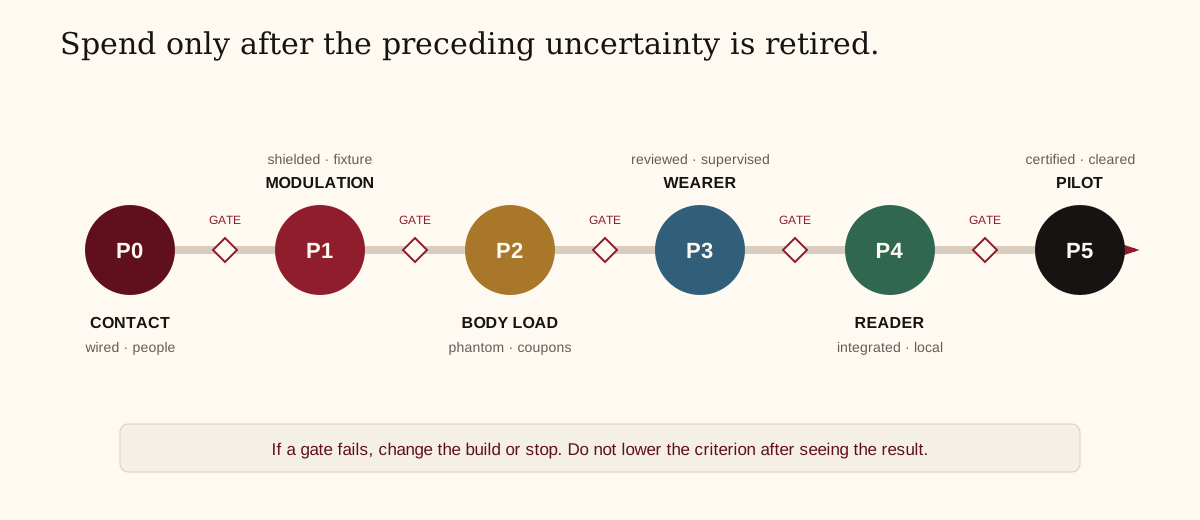
Wired, no RF. Establish placement, mechanical transfer, comfort, and wearer rejection.
The shortest responsible route is mechanical signal → passive modulation → body-loaded RF → integrated reader → product. Each gate prevents months of beautiful work around a broken assumption.
The first prototype is deliberately not wireless. Obtain a safe, isolated, battery-powered audio interface; a small piezo/PVDF contact element; compliant pads of several stiffnesses; a soft breakaway textile band; and an ordinary reference microphone. Do not connect a body-worn sensor to non-isolated mains-referenced bench equipment.
| Capability | Minimum | Why it exists |
|---|---|---|
| Mechanical/acoustic | Battery-powered isolated recorder, reference mic, force gauge, calipers, interchangeable compliant pads | Separates contact failure from RF failure. |
| RF measurement | VNA covering intended resonances, spectrum analyzer or calibrated SDR, attenuators, directional couplers, 50 Ω terminations | Measures resonance, Q, match, spurs, and receiver headroom. |
| Containment | Shielded enclosure or access to an RF lab | Keeps unapproved cross-band experiments from radiating. |
| Safety | Breakaway tensile fixture, temperature measurement, documented stop protocol | Neck-wear and RF exposure are product requirements, not paperwork. |
| Evidence | Versioned test scripts, calibration log, anonymized IDs, preregistered pass/fail | Prevents anecdote from becoming a requirement. |
Wired, no RF. Establish placement, mechanical transfer, comfort, and wearer rejection.
Bench fixture, no person. Prove sensor voltage changes the measurable passive response in a shielded setup.
Body phantom and enclosure. Map detuning, orientation, range, and repeatability.
Supervised, conservative, reviewed. Combine contact mechanics and RF; no unsupervised take-home.
Replace research instruments with a constrained puck, room channel, indicator, local storage, and physical mute verification.
Certified hardware, FTO cleared, jurisdictional consent UX, monitored small cohort, support and deletion operations.
Read SAFETY.md, copy the relevant test from DVP.md, assign a unique build ID, photograph the setup, record instrument and calibration IDs, run the test, attach raw results, and update claims.csv. If the architecture changes, write an ADR in decisions/.