01
Wearer channel
A compliant contact pad couples laryngeal vibration into a passive piezoelectric element. Its voltage perturbs a resonant RF structure.
A passive throat-contact choker that gives a visible reader puck a clean “wearer” channel. The puck supplies RF energy, records the room with consent, and turns two honest signals into useful meeting memory.
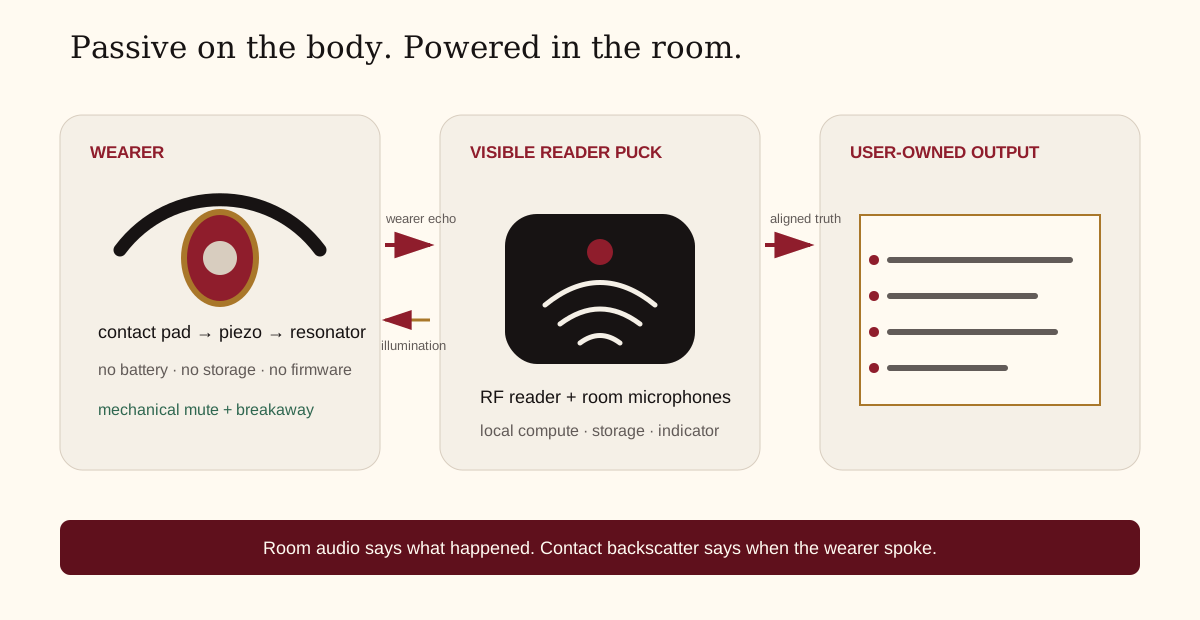
Use body vibration to label the wearer before AI, then use AI for restoration, alignment, transcription, and summarization—not to guess which room voice belongs to the wearer.
A compliant contact pad couples laryngeal vibration into a passive piezoelectric element. Its voltage perturbs a resonant RF structure.
A conventional microphone array lives in the reader puck, where battery, compute, indicators, thermal design, and serviceability belong.
Clock-aligned streams yield “me” and “meeting.” Contact-to-air coherence helps identify the wearer without relying only on voiceprints.
A mechanical mute opens the sensor path and detunes or shorts the tag. The puck’s indicator is driven by actual capture state.
| Status | Claim | Consequence |
|---|---|---|
| Demonstrated | The Soviet Great Seal device was passive and remotely illuminated; diaphragm motion altered the returned RF signal. | The physical principle is historical fact, not science fiction. |
| Demonstrated | TagMic (2025) reports a batteryless analog microphone using a piezo sensor, varactors, dual resonators, and frequency-separated backscatter. | A modern research prototype strongly validates the core mechanism. |
| Derived | A neck-contact channel plus a room channel should simplify wearer attribution. | Build and measure the fusion advantage; do not advertise it before validation. |
| Hypothesis | A jewelry-scale, body-loaded tag can achieve useful desk-range performance with a low-cost compliant reader. | This is the central engineering risk and the purpose of P1–P3. |
| Hypothesis | Users will prefer a batteryless choker and visible puck over a rechargeable pendant. | Run comfort, trust, and workflow studies before tooling. |
Stage gates, bench order, required tools, first-week checklist.
Boundaries, channels, interfaces, requirements, product states.
Physics, reference topology, antenna paths, regulatory trapdoors.
Contact mechanics, breakaway design, fit-check models, materials.
Demodulation, calibration, two-channel fusion, metrics, privacy.
Competitive wedge, PRD, economics questions, moat, launch ladder.
Neck-wear risk, RF exposure, FCC/RED, recording consent, data.
DVP, metrics, acceptance gates, evidence quality, test templates.
Primary sources, patents, product facts, freshness, uncertainties.
Launch-page concept, brand platform, campaigns, SVG art, and GUI-only Blender sources.
