Nine narrated, beat-synced visual lessons, three per paper. Each opens in its own player: space to play, arrow keys for slides, comma and period to step through the beats of a figure, square brackets for speed, d for links into the notes and the PDF at the right page.
Every spoken sentence was fact-checked against the PDF pages by a skeptic agent before narration, and anything that is our inference and not the paper's is flagged out loud. The core lessons end with two recall questions; the player pauses itself before each answer.
Suggested path: the three core lessons first (about 27 minutes at 1×, 18 at 1.5×), then the deep dive that pulls at you, then the report pages under each paper, then the PDF.
What this is
Three PDFs from Omer Tamuz's Caltech page, surveyed on 2026-09-17. All three have Omer Tamuz (Caltech, economics and mathematics) as a co-author. They share an author and nothing else: one is pure math (amenability of a monoid), one is a lab experiment (social learning), one is economic theory with random-matrix tools (taxes and subsidies under noisy demand estimates).
These pages are a reader's survey: the goal was to get the core of each paper into one reader's head, fast, with the central points first and the logical next place to read after each. The notes were drafted in markdown and rendered into this page with compiled LaTeX. Survey agents wrote the notes and the report pages; nothing here was typed into the HTML by hand.
Status: pass 2. Seven survey agents have read every page of all three papers, including appendices and figures, and written the report pages that sit under each paper in the left rail. Their corrections to the pass 1 notes are merged. Every claim on these pages carries a PDF page link so it can be checked in one click. Page numbers are PDF page numbers (what the viewer's page box shows).
A regulator who sees the demand system through heavy noise can still raise total surplus with high probability, by subsidizing along the top eigenvectors of the Slutsky matrix. It works when those eigenvalues grow faster than the noise's operator norm.
People who see everyone's raw data and everyone's past guesses guess better than people who see the raw data alone, although the guesses add zero information. Imitation patches bad counting when the evidence is close.
The monoid generated by "delete the th entry" maps is amenable, although every finitely generated piece of it is non-amenable. Equivalently: random finite sets exist that barely change in law when you delete their th smallest element.
Pure math
27
Who Omer is, and where the papers stand
From public pages (agent C1, full map in tamuz-map): Omer Tamuz is a professor at Caltech, primary division HSS (economics) with PMA (mathematics) listed second. His homepage and the admissions office page say he chairs the undergraduate First-Year Admissions Committee.
All three PDFs are byte-identical to the public copies on his Caltech page, so none is a private draft. Status: the taxes paper is forthcoming in the Journal of Political Economy (arXiv 2411.03026); the imitation experiment is published in the Journal of Economic Theory 235 (2026); the face-maps paper is published in Math. Proc. Cambridge Philos. Soc. 181(1).
Suggested reading order
Taxes first. For a reader whose native tools are linear systems, eigenmodes and identification under noise, it is the closest to home, and about 80% of the value of the set sits here.
Learning experiment second. Fast to absorb, one clean result, one three-parameter model. It also bears on how to run multi-agent systems (should workers see each other's conclusions or only the raw sources).
Deletion last. Shortest paper, furthest from that background. The payoff is a clean idea (amenability that "hides at infinity") and a brush with Thompson's group , a famous open problem.
A loose common thread (the survey's reading, not the authors')
Each paper has a result that only appears in the large limit and fails at every finite stage.
Deletion: each finitely generated submonoid is non-amenable; the union is amenable.
Taxes: with finitely many products and bounded eigenvalues the regulator can do nothing robust; with and a top eigenvalue that outgrows the noise, robust intervention exists.
Learning: the weakest instance of the pattern. Group size helps only when raw signals are shared; with actions alone 8 people do about as well as 4, which the authors loosely connect to a bound that is uniform in group size.
This is a reading aid. It is not a claim the papers make.
How to use this page
Left rail or keys 123 jump to a paper. h is this hub, g the glossary, s how this was made. [ and ] step through sections. ? shows keys.
Dotted-underlined terms are glossary terms. Hover for the definition, click to open the entry.
Small p.N chips open the PDF at that page.
"Check yourself" boxes are closed by default. Answer in your head, then open.
The depth pills at the top of a paper page filter it: L0 one paragraph, L1 mechanism, L2 results ledger, L3 proofs and appendices.
paper
Robust Market Interventions
Andrea Galeotti, Benjamin Golub, Sanjeev Goyal, Eduard Talamàs, Omer Tamuz
field Economic theory, industrial organization, high-dimensional statisticsdated 2026-08-01 draft; per agent C1's web search (not in the PDF): forthcoming in the Journal of Political Economy, arXiv 2411.03026; subsumes "Taxes and Market Power: A Principal Components Approach" (arXiv 2112.08153)status pass 2 (whole paper read by two survey agents, reports attached; corrections from both merged here 2026-09-17; skeptic pass pending)open PDF (60 pp)
depth
LessonsL0 · core
Narrated, beat-synced visual lessons. Start with the core lesson, then go deeper where you want.
Reports behind the lessons: taxes-core (the argument, fully derived) and taxes-limits (Monte Carlo, Proposition 3, the diagnostic, hedonic models).
Core bitL0 · core
Claim. A regulator (or a marketplace operator like Amazon) sees the matrix of cross-price demand effects only through heavy noise. Entry by entry, the estimate is useless. The regulator can still pick per-unit subsidies and taxes that raise total surplus with probability near 1, provided the true matrix has a few very large eigenvalues and the noise has a small operator norm by comparison. p.2
Mechanism. Subsidize along a top eigenvector of the normalized Slutsky matrix. In that direction prices barely move, quantities move a lot, and each dollar spent returns about two dollars of producer surplus and about zero change in consumer surplus. Top eigenvectors survive noise (Davis–Kahan); the rest of the matrix does not need to be known. p.14p.19
Consequence. The policy-relevant object in a huge market is a low-dimensional subspace, and the condition for it to exist ("significant structure") requires large-scale complementarities across families of products. Models built mainly on substitutability, the usual focus in hedonic demand work, do not have it. p.5
The setup in control termsL1 · mechanism
A control-theory dictionary for this paper. The right column is the survey's translation, not the authors' language.
Paper
Control reading
firms, one product each, price competition (Bertrand)
-dimensional plant at an equilibrium operating point
Per-unit subsidy vector (negative entries are taxes)
small input around the operating point
Slutsky matrix , negative semidefinite
the plant Jacobian; symmetric, so it has an orthonormal eigenbasis
Price response (normalized units)
closed-loop DC gain
Signal ,
noisy system identification
"-robust": property holds with probability in every state
frequentist worst-case guarantee, no prior over plants (Wald)
a few high-gain modes whose gain outgrows the identification noise
Everything is first order. "" means the derivative of outcome in direction at . The paper never computes a finite intervention. p.7
Normalization: rescale units so every own-price effect is , that is . Then each firm's first-order condition reads , which is what makes the algebra short. p.10
Step 1. The budget identityL1 · mechanism
For any intervention, with consumer surplus, producer surplus, the regulator's spend: p.11
Read it as a frontier. If consumers are not to be hurt (), the most the regulator can buy is , reached when all the incidence goes to producers. Total surplus is , and the identity gives . So with consumers held harmless () the best rate is one dollar of net surplus per dollar spent. This is a full-information identity; nothing about robustness enters yet. Without the constraint on consumers the rate is unbounded: tax a low- mode and subsidize a high one at zero net spend. With full information, for generic , every surplus triple on the plane is reachable as long as has one nonzero off-diagonal entry (Proposition 1, part 2). p.11
Monopoly sanity check: one firm, linear demand. A subsidy drops the price by . Consumers get half the spend, the producer gets all of it (half on old volume, half on new volume). . p.11
Why information is the binding constraint: . The inverse is sensitive to every entry of . With a noisy the regulator cannot even sign . p.12
Step 2. Spectral price theoryL1 · mechanism
Write with eigenvalues . Think of eigenvector as a bundle of products. A subsidy proportional to moves only that bundle's price and quantity; the other bundles do not respond. Lemma 1: p.14
So per dollar spent in direction : consumers get , producers get , net total surplus is . p.19 Two forces oppose each other as grows. Strategic interaction among the firms makes the bundle's equilibrium price less sensitive to the subsidy. Demand for the bundle gets more sensitive to its price (the slope of bundle demand in bundle price is exactly , a fact about demand alone). The second force wins, so quantity pass-through rises with while price pass-through falls. p.14
try it · where one subsidy dollar goes, by eigenvalue of the mode you aim at
to consumers
to producers
net total surplus
Surplus effects add across modes, each weighted by how much status-quo quantity sits on that bundle (Lemma 2 on p.15, combined with Lemma 1 as equation (10) on p.20):
Put all of on modes with huge and : the frontier from Step 1. Two things must hold: is not orthogonal to those modes (otherwise the intervention spends nothing and does nothing), and the regulator can find them.
Step 3. Significant structure and recoveryL1 · mechanism
Definition 2. There is a threshold such that: p.16
quantity noise is no bigger than quantities, ;
demand noise is small next to the threshold in operator norm, ;
has eigenvalues above in absolute value, and keeps a fixed fraction of its norm inside their eigenspace.
Why this is plausible: for independent bounded-variance entry noise, grows like , while a matrix with complementarities of fixed size spread across categories has a top eigenvalue that grows like . The running example is a block model: products within a category are substitutes, across categories complements (tennis rackets and tennis shoes). In the homogeneous version its top eigenvector is exactly the all-ones vector and ; in the general block model Lemma 3 gives a positive, category-constant eigenvector. The noise bound needs independent, mean-zero, uniformly bounded errors. p.12p.17p.39
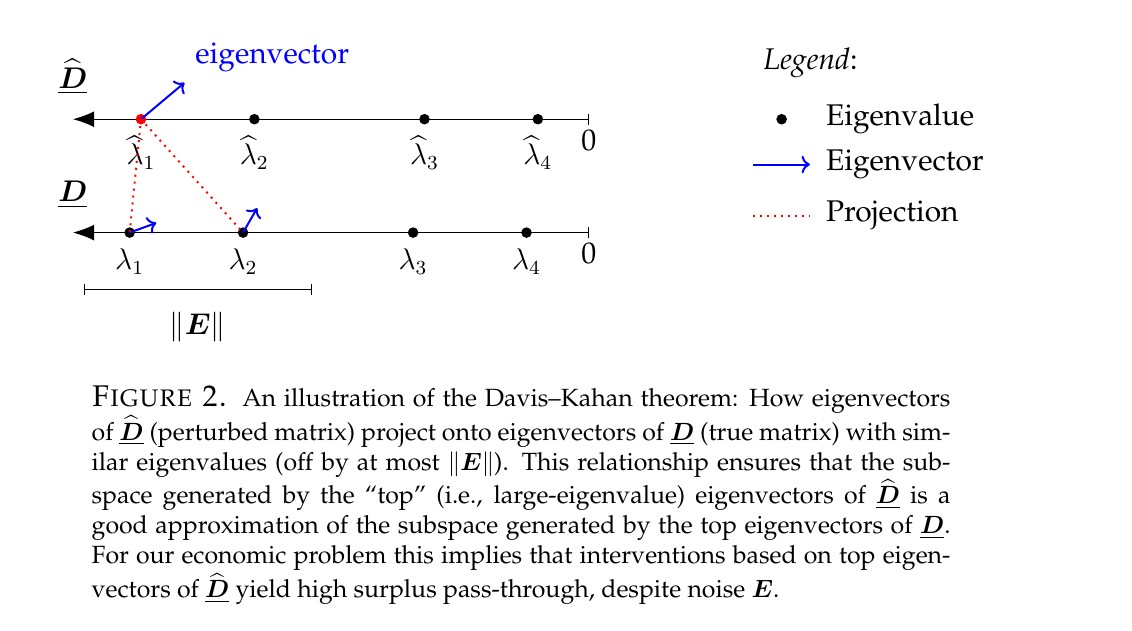
Recovery uses the subspace () form of Davis–Kahan, and it does not assume the large eigenvalues are separated from the rest of the spectrum or from each other. The proof manufactures its own gap with three thresholds: true eigenvalues above (the space ), estimated eigenvalues above (the computable space ), and true eigenvalues above (a buffer space ). Each comparison has a gap of , which dwarfs , so up to a vanishing tilt. No individual eigenvector is ever estimated. p.41p.42p.43 Full derivation: taxes-core.
The rule is a projection, so no sign is ever chosen: in normalized units. Estimated spend equals exactly. Quantity noise may be as large in norm as itself; it washes out because has at most dimensions (from and negative semidefiniteness), and independent noise spread over coordinates has almost no energy in so few. p.42p.44 The sign rule belongs only to the one-eigenvector sketch in the main text. p.20
Main theoremL2 · ledger
Theorem 1. Under significant structure and Assumptions 1 to 4, for any and target spend , for large enough a single rule achieves all of the following -robustly: (i) ; (ii) , and the same for every individual household; (iii) . p.18
The rule: normalize , project onto the span of eigenvectors of with eigenvalue above (the main text says ; the appendix proof needs the lower value), divide by the squared norm of the projection and multiply by . p.21p.42
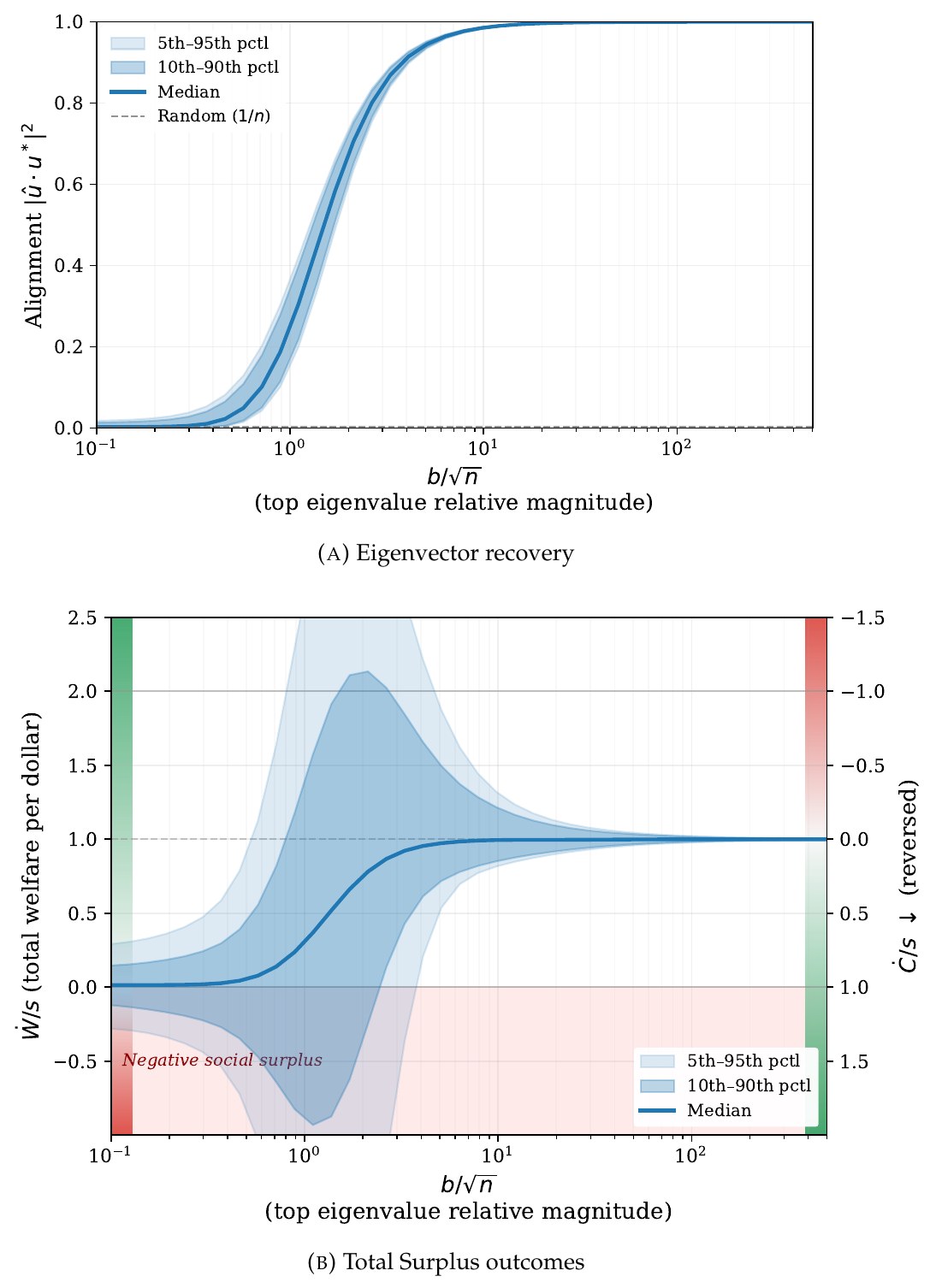
The figure to remember is the Monte Carlo in Section 7 (, two-block model with unknown block membership, Wigner noise). The horizontal axis is with ; the noise has operator norm about . Alignment and welfare-per-dollar switch on at . (Survey inference, confirmed by two independent re-simulations: that is half the noise norm and exactly the spiked-matrix (BBP) threshold, with squared overlap above it, and the Davis–Kahan bound is vacuous until about 4.) Reading Figure 3B: the 5th percentile of welfare is a loss from the left edge until about 3.7 and the 10th until about 2.4, including a stretch where the median is already above 0.5; the skeptic's re-run puts the share of losing runs at 42%, 18%, 7% at . The same band has a tail where consumers lose. Note the simulated example flips the sign pattern of Section 4: complements within blocks, substitutes across. p.22p.23p.24
Figure 3 of the paper: eigenvector recovery and total surplus per dollar against top eigenvalue over root n
Results ledgerL2 · ledger
Result
Statement, compressed
Page
Read?
Prop. 1
; full-information frontier is fully implementable
Constructed adversarial environments: (1) about states emit one signal; every rule's gain averaged over those states is , so in some state it earns at most that. The proposition bounds the guaranteed return (no rule robustly achieves ); it does not rule out improvement, and earns in every state of the construction; (2) the consumer-favoring direction has a statistically invisible sign. Neither shows impossibility under i.i.d. noise below threshold.
Diagnostic: cross-fit, score with Lemma 2 as if the second estimate were true, bootstrap a lower bound. T2 finds a noise floor near 0.87 at that the paper does not discuss.
This is "actuate only along well-identified high-gain modes." The full inverse is the fragile object; the top singular subspace is the robust one. The guarantee is worst case over plants and probabilistic only over the identification noise, which is the same split as in robust-control problems with stochastic sensor noise and an unknown-but-fixed plant.
bridge
Spiked random matrices
Confirmed by agent T2. In the paper's units the BBP threshold sits exactly at , and a re-run of Section 7 matches the overlap law to within 0.01 (the published Figure 3A is somewhat flatter, cause unknown). The paper uses the word "spike" and cites Davis–Kahan, Vershynin, Bandeira–van Handel and the Chen–Chi–Fan–Ma monograph, and cites no spiked-matrix paper. p.23p.36
Check yourselfL1 · mechanism
check yourselfA subsidy is aimed along an eigenvector with . Of each dollar spent, how much goes to consumers, producers, and net total surplus?
Consumers . Producers . Net total surplus . Check: , the budget identity.
check yourselfWhy can the regulator not just plug into and optimize?
The true operator is tame: is negative semidefinite, so every eigenvalue of is at least 1. The plug-in is the problem (survey inference, checked numerically by the skeptic). Noise of norm about makes indefinite, so has eigenvalues on both sides of zero and can be near singular (median smallest absolute eigenvalue 0.075 at ). The optimized would load on directions that look good only because of noise, and the sign of the true is not controlled. p.12p.14
check yourselfWhy does the definition of significant structure include a condition on the quantity vector ?
Two reasons. The spend in mode is , so if is orthogonal to the recoverable modes the intervention is a no-op. And the rule divides by , so the projection must stand clear of the projected quantity noise or the scale blows up (Lemma 5). p.43 In the one-eigenvector sketch the same condition is what lets the sign of be trusted. p.20
check yourselfWhy complements and not substitutes?
A short argument (from agent T2, not in the paper): if every off-diagonal entry is a substitute, write with entrywise. Negative semidefiniteness needs , and Perron–Frobenius gives . So every eigenvalue of lies in at any . Large eigenvalues need negative off-diagonal mass: complements. The paper's own argument runs on the utility Hessian: in hedonic models at Pellegrino's . p.60 Complements are needed somewhere, not everywhere: the Section 7 example has substitutes per good. p.22
Open questions for the surveyL3 · deep
A skeptic pass (taxes-verify) checked this note, the two reports and the core lesson against the PDF; its must-fix items are applied. Its one new observation: with observed exactly, weakly raises first-order welfare in every state with no knowledge of (from equation (9)), so what Theorem 1 buys is the rate, consumer neutrality and the spending target.
All eight are answered in taxes-core (questions 2 and 5) and taxes-limits (1, 3, 4, 6, 7). Question 8 (what the referees pushed on) was not pursued. One new criticism from T1: Appendix A.3 never invokes Assumption 4, and the normalization error is not automatically . p.41
Proposition 3, both parts: what exactly is impossible without significant structure, and why consumers cannot be robustly favored.
The no-gap subspace argument in Appendix A: what replaces per-eigenvector Davis–Kahan.
Section 8.2 diagnostic: statement, how it is computed, what it would take to run on real data.
Assumption 2 (own-price local linearity) and Section 8.4: how much breaks without it.
Which assumptions carry the "every household" clause of Theorem 1(ii).
Relation to Galeotti, Golub, Goyal (2020) "Targeting interventions in networks", which did the known-network version.
BBP question above.
What did the four referees likely push on? (Compare with the 2021 working paper if it can be found.)
Questions worth asking OmerL2 · ledger
Drafts after pass 1, to be sharpened or killed.
The guarantee is first order in . How large can the intervention get before the eigenbasis it was designed in has moved?
Is there an adversarial-noise version? The operator-norm condition seems to want independence across entries; a platform's estimates of would have structured errors.
Does significant structure show up in any real demand system you have looked at (the acknowledgments mention Pellegrino's data)?
paper
Learning Through Imitation: An Experiment
Marina Agranov, Gabriel Lopez-Moctezuma, Philipp Strack, Omer Tamuz
field Experimental economics, social learningdated 2026-05-17 draft; published in Journal of Economic Theory 235 (2026), article 106203; arXiv 2605.17662; NBER w29962; pre-registered as AEARCTR-0003315status pass 2 (whole paper and all appendices read by two survey agents, reports attached; corrections merged here 2026-09-17; skeptic pass pending)open PDF (84 pp)
depth
LessonsL0 · core
Narrated, beat-synced visual lessons. Start with the core lesson, then go deeper where you want.
Reports behind the lessons: learning-main (main text, every figure read) and learning-appendix (the 50-page appendix, audited).
Core bitL0 · core
Claim. Give a group the full public record of evidence. Then also show them each other's past guesses. The guesses are a deterministic-or-noisy function of evidence everyone already has, so they carry zero extra information, and the standard behavioral worries (herding, correlation neglect, overload) predict they should hurt. They help: about 5 percentage points more correct guesses on average across rounds, and about 10 points more consensus. p.13 Read the first number with its uncertainty: Table A.1 gives 0.051 with a session-clustered standard error of 0.028 (significant at the 10% level, 11 sessions). The consensus effect, 0.095 with the same standard error, is the statistically firm one. p.34
Mechanism. People count evidence badly when the tally is close. In exactly those rounds they lean on what others did last round; when the tally is lopsided they ignore others. Other people's guesses are a noisy copy of the correct count, so mixing them in denoises your own. p.16p.17
Consequence. Imitation is a cheap error-correcting code on top of bad individual inference. Too much of it is still harmful (everyone copying everyone ignores the data), so the benefit lives at a moderate weight p.32, and the paper estimates that weight p.29.
The gameL1 · mechanism
An urn is majority red (6 red, 4 green) or majority green, fair coin. Groups of 8. Twenty rounds. Each round every player guesses the urn's color, then gets one private draw with replacement, correct with probability 0.6. One random round of one random game pays $20 if correct and $5 if not, so there is nothing to hedge and myopic best-guessing is incentive compatible. Ten games per session, groups reshuffled each game. An on-screen table keeps the whole history, so memory is not a factor. 606 subjects, 31 sessions, UCSD lab and OSU online. p.6p.8
Four information treatments, all on top of your own signals: p.7
Treatment
See others' signals
See others' past actions
Group
Subjects
no info
no
no
1
80
actions
no
yes
8
136
signals
yes
no
8
82
all
yes
yes
8
152
actions4, all4
same as above
4
76, 80
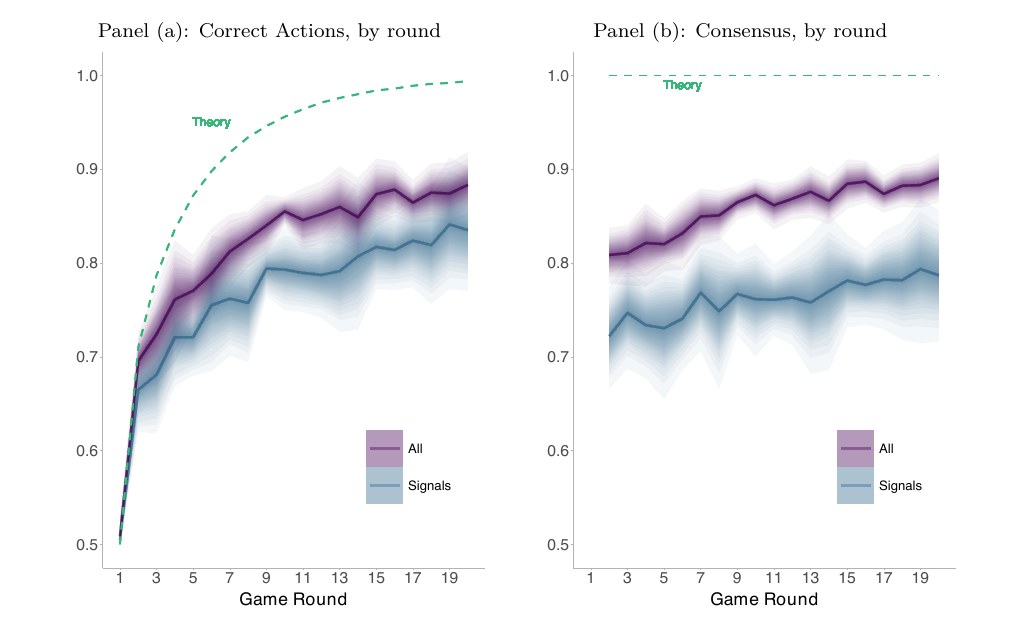
The headline comparison is signals against all. A Bayesian does identically in both: guess the color that is ahead in the pooled tally. The Bayesian benchmark hits 0.96 by round 10 and above 0.99 by round 18. p.10
What happenedL1 · mechanism
Figure 1 of the paper: share of correct guesses and consensus by round, all versus signals, with the Bayesian benchmark dashed
Both groups fall well short of the Bayesian curve, ending near 0.83 to 0.88 where theory says 0.99. The all group sits above the signals group from the early rounds on. p.12
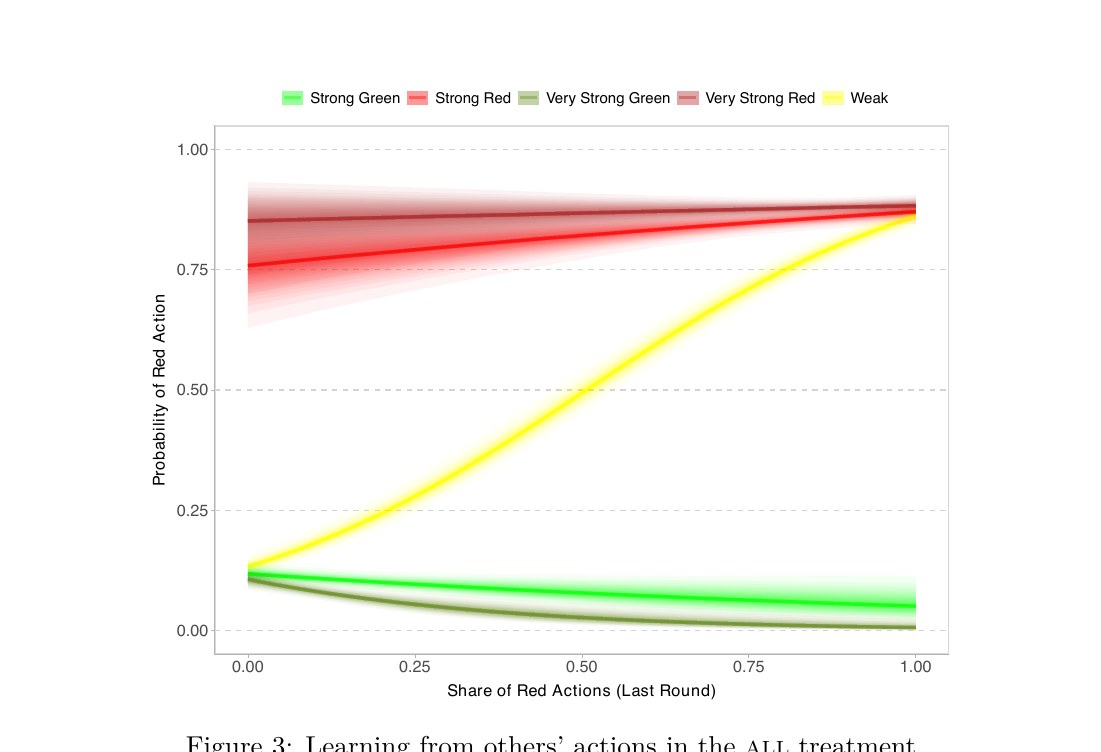
Figure 3 of the paper: probability of guessing red against the share of others who guessed red last round, by signal strength
This is the mechanism figure. Flat lines at top and bottom: when the pooled tally is lopsided, what others did has almost no effect on your guess. The steep yellow line: when the tally is close (difference within 14, the middle 50% of end-of-game histories; cutoffs on p.11p.12), your probability of guessing red runs from about 0.13 to about 0.86 as the share of others guessing red goes from 0 to 1. p.16 Caution from agent L1: inside the Weak bin the tally and the peers' share still move together, so this 0.73 swing overstates the causal effect. The structural model puts the effect of flipping one sampled peer at 0.31. The paper's own Figure 9 shows the same artifact. p.30
The paper's four numbered observations, compressed:
Seeing signals and actions beats seeing signals alone, in accuracy and in consensus. p.14
In both treatments people use the signals worse than a Bayesian would, mostly when the tally is close. In all they patch those errors with others' actions. p.17
High-IQ subjects (six ICAR items) process the raw signals well with or without social information. Low-IQ subjects do not, and do badly without it. Both groups condition on others' actions, almost only when signals are weak, and both gain. p.20 The low-IQ gain is no larger than the high-IQ gain (interaction +0.010, SE 0.031, Table J.2). p.64
With signals and actions visible, groups of 8 learn faster than groups of 4 (all minus all4 = 0.065, SE 0.023). With actions only the difference is 0.008 (SE 0.022). p.35 The authors link this to Harel, Mossel, Strack, Tamuz (2021, "Rational Groupthink"), and call the link "quite a loose interpretation" themselves. p.22 The interval for the actions effect also contains the 0.04 to 0.05 gap that myopic Bayesians would show (Table 2), so the data cannot separate "no effect" from "the Bayesian effect".
Private-information side result: actions beats no info by a wide margin (the footnote gives 5.3 points early, 9.6 points late), although extracting private signals from repeated actions is a hard inference problem in theory. p.22
The three-parameter modelL1 · mechanism
Each round, player looks at two numbers. is the pooled signal tally (red , green ) divided by the number of signals raised to a power . is the last-round action of one randomly chosen other player. The player guesses red with logistic probability: p.22
That is the likelihood used for estimation in Section 6.2, where the sampled peer is latent and integrated out against the share of others who guessed red. p.26
check this
A units inconsistency between Section 6.1 and Section 6.2 (found in pass 1, ruled on by agent L1)
Section 6.1 describes the choice rule as "probability proportional to " and simulates at . Section 6.2 estimates with , and Table 3's probability effects pin that scale exactly: . p.29 L1 re-simulated 20,000 games per cell against eleven read-offs from Figures 6 and 7. The curves with no imitation match only with doubled. The imitation curves fit an effective of 0.8 to 1 and reject 2. So in Table 3 units the illustration is about , close to the estimates. the survey's first reading (both doubled, "subjects imitate far less than the illustration") was half right and its conclusion is withdrawn. Details: learning-main.
is the Bayesian sufficient statistic (raw difference). is the sample proportion, the usual choice in the behavioral literature. Estimates land between 0.52 and 0.63, which the paper calls closer to a square-root scaling than to the sample proportion (0.5 itself lies outside the credible intervals for signals and all): two reds alone feel stronger than 102 reds against 100 greens, but less drastically than proportion-thinking implies. p.23p.28 L1 adds that may be absorbing inattention: the model has no lapse rate, and about a quarter of subjects in two treatments act as if random (Appendix N).
Parameter
no info
signals
actions
all
(weight on tally)
1.05
1.02
1.27
1.27
(weight on a peer's last action)
0.97
0.65
(tally normalization)
0.52
0.57
0.52
0.63
Posterior medians from Table 3. In all, flipping the sampled peer from green to red moves by 0.31, about the same as a one standard deviation move in (0.29). p.29
Why helps here: the mistake probability depends on the sign and size of . is correlated with the sign of because peers mostly follow the tally. Adding it usually pushes the sum the right way, and it matters most when , where your own response is close to a coin flip. p.24
Survey replication, 3,000 simulated games at the Table 3 medians: all ends at 0.86 and signals at 0.83 in round 20, close to the data in Figure 1. Holding and at the all estimates and sweeping , round-20 accuracy climbs from 0.82 at to about 0.90 on a flat top from 1.75 to 2.6, then collapses (0.68 at ). Under the paid objective (mean accuracy over rounds) the optimum is about 1.5 and the gain over the subjects' 0.65 is about 2 points (skeptic re-run, 80,000 games per point). That is a simulation by the survey on the paper's model, and the paper does not claim it.
try it · the three-parameter model, simulated in your browser (2,000 games per curve)
sees signals and actions (your ) sees signals only () Bayesian benchmark
Bridges to adjacent fieldsL1 · mechanism
bridge
Noisy decoders and a redundant channel
Each subject is a noisy decoder of a sufficient statistic. A peer's action is the output of another noisy decoder of the same statistic. No new information about the urn enters, yet averaging two noisy decodes of one codeword lowers decode error. The Bayesian argument "actions are redundant" assumes a noiseless decoder. This is the whole paper in one sentence, and it is the survey's phrasing, not the authors'.
bridge
Multi-agent systems (speculation)
The same design question arises when fanning out AI subagents: do workers see only the raw sources, or also each other's conclusions? For humans this paper says conclusions help, most when evidence is close; the gain is no larger for low-IQ subjects p.64 and is largest for the lower quantiles of realized performance p.72; and that the help saturates with group size unless raw data is also shared. A common operating rule for LLM workers (never treat another agent's summary as a source) points the other way, because a wrong summary is copied with confidence. The paper's own caveat applies: too much weight on others is harmful, and it never tests a confidently wrong peer. The discussion section names that as future work ("ideological agents whose actions are independent of the data"). p.32
bridge
Self-consistency in LLM sampling (speculation)
Majority vote is not a corner of this model (corrected by the skeptic). At and large each player copies one randomly sampled peer, which is a voter-model step with no pull toward the majority. The analogue of self-consistency would be a variant that responds to the share of peers through a threshold, which the paper does not study.
Check yourselfL1 · mechanism
check yourselfWhy would a Bayesian do exactly as well in signals as in all?
In both she sees every signal ever drawn. Others' actions are functions of those same signals (plus noise that is independent of the urn), so conditioning on them cannot change her posterior.
check yourselfIn Figure 3, why are the top and bottom lines flat while the middle one is steep?
With a lopsided tally, dominates and the guess follows the data whatever the peers did. With a close tally and the term decides.
check yourselfGroup size helps in all and does nothing in actions. One sentence why.
In all, a bigger group means more raw draws per round in the shared tally. In actions, more peers mostly means more copies of correlated guesses, and the information that can be squeezed out of actions saturates (Harel et al. 2021).
check yourselfWhat does mean in plain words?
People weigh a lead of signals out of roughly like . That happens to be the scale of a z-score for the tally, so subjects behave as if judging "how many standard deviations ahead is red". (The z-score remark is the survey's, not the paper's.)
Audited in learning-appendix: effect sizes with SEs (A), stated strategies (B), beliefs (C), instructions and screenshots (D, E), lab versus online (F), learning across games (G), cutoff robustness (H), RMSE value of actions (K), heterogeneity (L), covariate balance (M), random-acting subjects (N)
A skeptic pass (learning-verify) checked this note, both reports and the core lesson against the PDF, re-ran the units ruling (agrees: doubles, does not) and the sweep. Two facts it added: the paper's subject-level measure finds high-IQ subjects rely on others more () p.20, and Appendix L finds the treatment effect largest in the lower quantiles of realized performance p.72.
Answered in learning-main (1, 5, 7) and learning-appendix (2, 3, 4, 6). The short version of the audit: the lab-versus-online confound is never directly tested (Appendix F compares only all at UCSD with all at OSU and prints no numbers; L2's digitized within-online gap is about 5.4 points, with no usable standard error; by subjects all is 64 UCSD and 88 OSU); Appendix N covers only no info and signals and never re-runs the headline without the random-acting quarter; the screen shows no running tally, so part of the counting noise comes from the interface (agent inference). p.8p.51p.56
Exact model normalization and estimation (Section 6.2): hierarchical? per-subject? How was "one random peer" handled in the likelihood?
Is the +5 point effect robust to the lab-versus-online split? Signals ran only online at OSU; all ran half in the UCSD lab, half online. That is a confound worth reading Appendix F for. p.8
Appendix K: how much of the gap to the Bayesian benchmark does imitation close, in RMSE terms?
Appendix N: how many subjects are effectively random, and do results survive dropping them?
Is there an optimal ? the survey's sweep says yes, near 2 for . The authors mention a formal analysis and conjectures as future work; find where and what, and whether they note that subjects under-imitate.
What do subjects say they did (Appendix B, open-ended strategies)?
Observation 3 details: size of the low-IQ gain.
Questions worth asking OmerL2 · ledger
Drafts after pass 1.
With a peer who is confidently wrong on purpose, where does the benefit of imitation break? (They flag this as future work.)
Does the normalization suggest subjects are doing significance testing in their heads?
For a fixed decoder noise , what maximizes group accuracy, and do subjects sit near it?
paper
A Fixed-Point Theorem for Face Maps, or Deletion-Tolerant Random Finite Sets
Tom Hutchcroft, Nicolas Monod, Omer Tamuz
field Pure math (amenability, semigroups, ergodic theory)dated compiled 2025-06-25; arXiv 2505.21484v2; published in Math. Proc. Cambridge Philos. Soc. (per agent D2's web search; volume and pagination unresolved)status pass 2 (whole paper read by two survey agents, reports attached; corrections merged here 2026-09-17; skeptic pass pending)open PDF (27 pp)
depth
LessonsL0 · core
Narrated, beat-synced visual lessons. Start with the core lesson, then go deeper where you want.
Reports behind the lessons: deletion-proofs (line-by-line proof read) and deletion-context (Appendix B, amenability, Thompson's , Moore, Ryll-Nardzewski).
Core bitL0 · core
Claim. Take a finite set of integers and delete its th smallest element; call that map . For any and any there is a finitely supported random finite set whose law moves by less than in total variation under every one of (Theorem A). The companion result: any infinite family of continuous affine maps of a compact convex set that satisfies the face relations for has a common fixed point (Theorem B). The paper calls the two "two visages of the same phenomenon" and derives both from one idempotent mean; it does not claim they are equivalent statements. p.3p.1p.2
Mechanism. Build a "random walk" whose step distribution is an idempotent mean on , a finitely additive probability measure sitting at infinity with . Deleting any entry of its -point trajectory gives exactly its -point trajectory, because merging two adjacent steps is a convolution and the convolution changes nothing. Then approximate that impossible object by honest finitely supported distributions using Day's Hahn–Banach argument. p.5p.6
Consequence. The monoid presented by the face relations is amenable. Each submonoid generated by with is non-amenable. For groups that cannot happen, since every subgroup of an amenable group is amenable. The authors' phrase: the amenability of "hides at infinity." is a quotient of the positive monoid of Thompson's group , whose amenability is a famous open problem. p.2p.3
Why the two theorems are one theoremL1 · mechanism
Day's theorem: for a monoid the following are equivalent. (1) Every action of by continuous affine maps on a nonempty compact convex set has a fixed point. (2) has a left-invariant mean. (3) For every finite and there is a finitely supported probability on with for all . p.12
Theorem B is (1). Theorem A is the same kind of statement as (3), for the deletion maps acting on finite sets. Precision from agent D1: the paper proves Theorem A directly on finite sets in Section 2 and never passes through ; Sections 3 and 4 exist to move the same mean onto and get Theorem B. The identification of with finite sets:
Every element of has a unique flat normal form with (rewrite until stuck; termination and local confluence, then Newman's lemma). So as a set. p.10
Under that identification, left multiplication by is : fill the th hole of the set (adjoin the th smallest integer not in it). p.11
Taking complements inside swaps "fill the th hole" with "delete the th element" on a suitable class of sets ("pin-headed": nonempty, and ). p.7p.8
So the level-lowering means become level-lowering means for hole-filling, and a Cesàro limit over all levels is a left-invariant mean on , which is amenability. p.9
try it · deleting entries and filling holes are the same action seen through a complement
pin-headed set (gold). Buttons apply : delete the th smallest element.
its mirror (blue). Buttons apply : fill the th hole.
The proof of Theorem A in five movesL1 · mechanism
Pick . Take any invariant mean on (an accumulation point of uniform distributions on , equivalently a Banach limit flavored Cesàro limit). It satisfies : convolving it with itself gives it back. It gives mass zero to every finite set, so think of it as "a random very large number." p.4p.5
Walk. Define on increasing -tuples by iterating: with . Loosely, is the law of the first positions of a walk with i.i.d. steps. Only loosely: Fubini fails for means, and the definition is the (non-commutative) Arens product. p.4
Theorem 2.3: for every . Deleting the last position obviously gives the -step walk. Deleting position in the middle merges steps and into one step of law , so again a -step walk. The written proof is this idea done carefully with the order of the nested means respected, plus an induction for . p.5p.6
Average over . is within of each . An accumulation point is exactly invariant under . p.6
Come back to earth. Finitely supported probabilities are weak-* dense in means (Goldstine). Weak convergence of upgrades to norm convergence after passing to convex combinations (Mazur's trick, which is Hahn–Banach). Norm in is twice total variation. p.6p.7
What is lost: constructiveness. The proof uses choice-type arguments several times (D1 counts at least four) and gives no rate. With a genuine countably additive step law the walk cannot work: stays at total variation distance more than from (Proposition A.1). The introduction says an explicit construction could be verified only for , but that verification is written nowhere in the paper; Appendix A offers a conjectural tower-of-exponentials model and says closeness holds for marginals, pairs and triples. p.3p.19p.20p.21 D1 also notes the mean "walk" is scale-ordered (the first step exceeds the second with mean-probability 1), which no i.i.d. walk can imitate; see deletion-proofs.
The Polish monoids of order-preserving maps of are amenable as topological monoids (a dense amenable submonoid suffices) and non-amenable as abstract monoids (the "waltz" map on diffuse means forces )
Exchangeability (survey observation, confirmed by agent D2)
Proposition 6.1 looks like the Ryll-Nardzewski theorem in different clothes. A law on sequences that is invariant under deleting any coordinate is what probabilists call contractable or spreadable, and Ryll-Nardzewski (1957) showed spreadable is the same as exchangeable, so by de Finetti it is a mixture of i.i.d., and the ergodic ones are i.i.d. The paper calls its result "a De Finetti type theorem" and the text dump contains neither "Ryll", "spreadable", "contractable" nor "Kallenberg". D2's ruling: deletion invariance is exactly contractability (finite-dimensional marginals suffice, no approximation needed), none of the paper's 17 references is on exchangeability, and the proof adds one thing: it needs no standard-Borel hypothesis on the state space. See deletion-context.
bridge
Stationarity under thinning
For an engineer the picture is a point process on whose law does not change when you drop its th point. A renewal process with i.i.d. gaps is invariant under dropping a point only if the sum of two gaps has the law of one gap, which no real distribution satisfies. The proof gets around this with a gap law that lives at infinity, then pulls back an approximation. The lower bound says any honest renewal process is a bad approximant, so the good finite approximants must look quite different from a renewal process. What they look like is open.
bridge
Simplicial objects
for are the face-map identities of a simplicial set, with all dimensions glued into one monoid. Theorem A then says: an infinite-dimensional simplicial complex carries random simplices that are almost invariant under passing to a face. p.2
Check yourselfL1 · mechanism
check yourself. Compute and . Which face relation do you see?
Maps compose right to left. : first , then gives . : first , then gives . They differ, so the maps do not commute. The face relation (for ) repairs the order: with it says , and indeed , then gives . Reason: once the th element is gone, what used to be the th element sits in position .
check yourselfWhy can a true probability distribution on never be convolution-idempotent?
If are i.i.d. positive integers then always, so cannot have the law of . (The paper notes that on the only finitely supported idempotent is the point mass at 0.) A mean can be idempotent because it gives zero mass to every finite set, so "adding a very large number to a very large number" is again just "a very large number."
check yourselfWhy is non-amenable?
On any compact convex with two points , let be the constant map to and the constant map to . Every truncated relation has , so the outer map on each side is one of and both sides are the constant map to . The only fixed point of is and the only fixed point of is , so there is no common one. Lemma 4.4 is needed to know these truncated relations are all the relations in .
check yourselfWhere does the argument use that there are infinitely many generators?
In , the relation always has room for . Invariance under is bought by pushing the defect out to higher and higher indices (the Cesàro average over in move 4), and there is always a higher index to push to.
Open questions for the surveyL3 · deep
Answered in deletion-proofs (1, 3 in part, 6, 7) and deletion-context (2, 3, 4, 5, 7). Two corrections to what is written below. Moore's two cited papers are a conjecture and its refutation: [Moo15] showed an idempotent mean on the free nonassociative magma would make amenable, and [Moo19] proved no such mean exists; the "echo" is that this paper runs the same idempotent-mean strategy on the associative , where idempotents do exist. And the direction of inference: is a quotient of , so amenability of would imply Theorem B and not the reverse. D1 also found three small slips in the paper (an off-by-one in the factor map of Prop. 6.3, a subscript on p.17, a plus sign for a product on p.20).
Appendix A: the conjectural explicit model, and the verification.
Theorem B.1 proof: why topological amenability but not abstract amenability.
Proposition 5.3 and the Klawe reference: the asymmetric Følner phenomenon in one paragraph.
Moore's work on ([Moo15], [Moo19]) and what "echoes" means on p.3.
The Ryll-Nardzewski question above.
Is there any quantitative version of Theorem A? How large must the support be as a function of ? The paper says none is known. p.7
What would amenability of need beyond Proposition 5.5? Why does the embedding into an amenable monoid not finish the job? (Submonoids of amenable monoids need not be amenable. This paper's own is an example. Confirm that is the whole obstruction.)
Questions worth asking OmerL2 · ledger
Drafts after pass 1.
What do the almost-invariant random sets look like? The bound kills renewal processes; is there a guess for ?
Is Proposition 6.1 Ryll-Nardzewski, and if so was the proof the reason to include it?
Did this come out of a probability question (the title's second half) or out of (the first half)?
report
Omer Tamuz, a map of the research program
status web survey on 2026-09-17 of his Caltech homepage, Caltech HSS and admissions pages, arXiv listings (81 entries), Crossref, Cambridge Core and the Math Genealogy Project; public PDFs hashed against the surveyed copies; no paper proofs read here
How to read this page
Every factual claim links to the public page it came from; this report has no PDF of its own, so links replace page chips. "(agent inference)" marks my own reading. Result statements are compressed from public abstracts. I read no proofs for this report.
Provenance finding: the three PDFs are the public copies
The three surveyed files are byte-identical to the PDFs on his homepage. I downloaded taxes.pdf, learning_experiment.pdf and deletion.pdf and compared MD5 hashes with the surveyed copies. All three match (taxes 632481f0..., learning 505f07d1..., deletion 2c0ec1af...). The hub's worry that these might be private drafts is settled: they are public postings. The PDFs carry no confidentiality.
1. Who he is
Appointment. Professor of Economics and Mathematics at Caltech, in the Division of the Humanities and Social Sciences. He was Assistant Professor 2015 to 2019 and Professor from 2019 (HSS page). The same page lists him as a member of the Division of Physics, Mathematics and Astronomy, the Linde Institute, the Center for Social Information Sciences (CSIS) and the Center for Theoretical and Experimental Social Sciences. The CMS department page also carries a profile with the same title. His office is Baxter Hall 213 (homepage).
Admissions role. Found. His homepage says he is "the chair of Caltech's undergrad admissions committee" and links to the admissions office's faculty page (homepage). That page names him as "Chair, First-Year Admissions Committee" and says more than 20 faculty do full reviews of applications after staff review (Caltech admissions). The HSS page repeats the role. This matches the "Omer" in the hub's open identity question on title and on the PMA membership. Note the public title is First-Year admissions. I found no public page that ties him to transfer admissions specifically.
Training. B.Sc. in computer science and physics, Tel Aviv University (2006), where he worked on extrasolar planet searches with Tsevi Mazeh. M.Sc. (2010) and Ph.D. in mathematics (2013) at the Weizmann Institute, advised by Elchanan Mossel (homepage, HSS page). Thesis title: "Learning, Agreement and Computation on Social Networks" (Math Genealogy). Schramm postdoctoral fellow at MIT mathematics and Microsoft Research, 2013 to 2015, after an internship with Adam Kalai at Microsoft Research (homepage). His list also has astronomy papers from 2005 to 2010 and two ICML papers with Kalai.
Awards and support. Sloan research fellowship in mathematics, NSF CAREER award (DMS-1944153), a MURI grant, a BSF award, a Simons Foundation award. Paper prizes: EC'20 best paper for "Feasible joint posterior beliefs" and MATCH-UP 2024 best paper for "The power of two in token systems" (homepage).
Students. Math Genealogy lists three PhD students: Pooya Vahidi Ferdowsi (2020), Joshua Frisch (2021), Michael Wolman (2025) (Math Genealogy). The first two co-wrote the Annals paper below.
Editorial roles. Not found. His homepage lists none. He does not appear on the current Econometrica editorial board or the current Theoretical Economics board. I found no public CV. A search engine summary asserted associate editorships with no source page behind it; I discard it.
2. The research program in seven threads
The homepage's own description: "probability, dynamics and group theory, and in their applications to topics in microeconomic theory, including information, risk and uncertainty, and social choice" (homepage). All venue and year data below come from that page's publication list.
Thread A. Social learning and information aggregation
Recurring idea: agents who watch each other's actions (coarse functions of beliefs) recover only part of what the group knows, and the question is how much, how fast, and on which network.
Asymptotic learning on Bayesian social networks (Mossel, Sly, Tamuz; Probability Theory and Related Fields 2014). Bayesian agents on a graph repeatedly see neighbors' best guesses of a binary state; the paper gives sufficient conditions on graph families under which, with probability tending to 1, everyone ends up correct, and counterexamples when the conditions fail (arXiv 1207.5893).
Strategic learning and the topology of social networks (Mossel, Sly, Tamuz; Econometrica 2015). With strategic agents, a geometric "egalitarianism" condition on the network guarantees learning in every equilibrium, and non-egalitarian networks have equilibria where learning fails (arXiv 1209.5527).
Rational groupthink (Harel, Mossel, Strack, Tamuz; QJE 2021). See section 3(b). Extended to networks and forward-looking agents in Learning in repeated interactions on networks (Huang, Strack, Tamuz; Econometrica 2024): in any equilibrium, on any network, for any patience, the speed of learning is bounded by a constant that depends only on the private signal distribution (arXiv 2112.14265).
Two surveys frame the thread: Opinion exchange dynamics with Mossel (Probability Surveys 2017, written for mathematicians, arXiv 1401.4770) and Information cascades and social learning with Bikhchandani, Hirshleifer and Welch (Journal of Economic Literature 2024, arXiv 2105.11044).
Thread B. Random walks on groups, boundaries, and strong forms of amenability
Recurring idea: classify groups by whether some averaging object at infinity is trivial. A bounded -harmonic function is a function on the group with ; the Poisson boundary is the space that parametrizes all of them, and it is trivial exactly when they are all constant.
Choquet-Deny groups and the infinite conjugacy class property (Frisch, Hartman, Tamuz, Vahidi Ferdowsi; Annals of Mathematics 2019). A countable group has only constant bounded harmonic functions for every non-degenerate step distribution if and only if no quotient has the infinite conjugacy class (ICC) property, meaning every non-identity element has infinitely many conjugates; for finitely generated groups this is the same as virtually nilpotent (arXiv 1802.00751). The arXiv listing says 14 pages.
Strong amenability and the infinite conjugacy class property (Frisch, Tamuz, Vahidi Ferdowsi; Inventiones 2019). A group is strongly amenable if every proximal action on a compact space has a fixed point; the same ICC criterion characterizes it (arXiv 1801.04024).
Thompson's group F is not strongly amenable (Hartman, Juschenko, Tamuz, Vahidi Ferdowsi; Ergodic Theory and Dynamical Systems 2019). They build a proximal action of on a compact metric space with no fixed point (arXiv 1607.04915).
Thread C. Entropy, stationary measures and ergodic theory
Recurring idea: entropy as a numerical invariant of a random walk or a group action, and the question of which values and which measures can occur.
Generic stationary measures and actions (Bowen, Hartman, Tamuz; Transactions of the AMS 2017). For a finite-entropy walk, a generic stationary measure on a shift space is an essentially free extension of the Poisson boundary (arXiv 1405.2260).
On the spectrum of asymptotic entropies of random walks (Tamuz, Zheng; Groups, Geometry, and Dynamics 2024). The set of asymptotic entropies of the walks induced on quotients of a free group has no isolated points except perhaps its maximum (arXiv 1903.01312).
Asymptotic Rényi entropies of random walks on groups (Golubeva, Pan, Tamuz; Electronic Journal of Probability 2024). A one-parameter family of invariants that interpolates between growth rate, Shannon entropy and spectral radius and gives large-deviation versions of Shannon-McMillan-Breiman (arXiv 2307.15827).
Thread D. Value and cost of information, Blackwell order
Recurring idea: compare or price experiments (signal structures) by axioms that are additive over independent experiments, then show the axioms force a specific functional form. The Blackwell order ranks experiment above when every decision maker prefers .
From Blackwell dominance in large samples to Rényi divergences and back again (Mu, Pomatto, Strack, Tamuz; Econometrica 2021). For a binary state, i.i.d. copies of one experiment eventually Blackwell-dominate copies of another, generically, if and only if the first has higher Rényi divergences of every order (arXiv 1906.02838).
The cost of information: the case of constant marginal costs (Pomatto, Strack, Tamuz; AER 2023). If cost is additive over independent signals, linear in the probability of running the signal, Blackwell monotone and continuous, then the cost function is pinned down up to a vector of parameters that measure how hard each pair of states is to tell apart (arXiv 1812.04211).
Feasible joint posterior beliefs (Arieli, Babichenko, Sandomirskiy, Tamuz; JPE 2021, EC'20 best paper). Characterizes which joint distributions of posteriors can arise from a common prior, through a quantitative agreement theorem for two agents and a no-trade condition for many (arXiv 2002.11362). Private private information (JPE 2026) continues it.
Thread E. Risk, stochastic dominance and background risk
Recurring idea: add an independent noise term and see which orderings of gambles survive or appear.
Stochastic dominance under independent noise (Pomatto, Strack, Tamuz; JPE 2020). If , there is an independent noise such that first-order stochastically dominates ; a second-order version yields an elementary axiomatization of mean-variance preferences (arXiv 1807.06927).
Background risk and small-stakes risk aversion (Mu, Pomatto, Strack, Tamuz; AER: Insights 2024). Under plausible background risk no theory of choice can be risk averse over small gambles, respect stochastic dominance and account for background risk all at once (arXiv 2010.08033).
Monotone additive statistics (same authors; Econometrica 2024). Complete characterization of the statistics of a random variable that are monotone in stochastic dominance and additive over independent sums (arXiv 2102.00618). On the origin of the Boltzmann distribution (Sandomirskiy, Tamuz; Mathematische Annalen 2025) uses the same kind of semigroup argument to characterize Boltzmann distributions by independence of uncoupled systems (arXiv 2307.11372).
Thread F. Networks, markets and coordination
Recurring idea: the geometry or spectrum of an interaction structure decides what a planner or a population can achieve.
Robust market interventions and its 2021 ancestor. See section 3(a).
Local coordination and the geometry of social networks (Hutchcroft, Rospuskova, Tamuz; working paper, EC'26). In a pure coordination game with only local communication, a geometric condition on the network characterizes when near-perfect efficiency is reachable (arXiv 2602.12571). This is the other Hutchcroft collaboration.
Thread G. Social choice, mechanisms and algorithms
Symmetry and combinatorics applied to voting and allocation: Equitable voting rules (Econometrica 2021), The power of two in token systems (Management Science, forthcoming), and the early Arrow's-theorem characterization with Mossel (2012). Listed on the homepage; I did not read these abstracts, so no result statements. None of the three papers sits here.
Math. Proc. Cambridge Philos. Soc. 181(1), 751 to 772, online 2026-03-26 (Cambridge Core)
B
(a) Robust Market Interventions
Status. The surveyed file is the homepage copy compiled 2026-08-01, newer than arXiv v3 (printed 2026-06-09). The first page of both says the paper "subsumes the working paper Galeotti et al. (2021)". The v3 arXiv abstract calls the key condition "recoverable structure" (arXiv), while the body of v3 and of the surveyed copy says "significant structure" throughout (75 and 73 occurrences against one "recoverable structure" each, in the bootstrap-test appendix). (agent inference) The authors are mid-rename; expect the JPE version to pick one term.
The subsumed 2021 paper is Taxes and Market Power: A Principal Components Approach, same five authors (arXiv 2112.08153, v1 2021-12-15, v2 2022-06-28). It already has the eigenbundle basis: a tax on an eigenbundle passes through only to that bundle's own price, with a coefficient set by the eigenvalue. It solves the full-information problem: a planner maximizing consumer surplus under budget balance taxes low pass-through eigenbundles and subsidizes high pass-through ones, and the achievable gain ("Pigouvian leverage") depends only on the dispersion of the eigenvalues. (agent inference) The 2024 paper keeps the spectral pass-through formulas and replaces the full-information planner with a noisy-signal regulator, which is where Tamuz's probability toolkit enters; this answers open question 6 of the taxes note together with the next paragraph.
Targeting Interventions in Networks (Galeotti, Golub, Goyal; Econometrica 88(6), 2020, 2445 to 2471). In three sentences, from the abstract. Players on a known network choose investments with spillovers, and a planner with a budget shifts each player's private return to investment. The authors decompose any intervention into orthogonal principal components of the network matrix, ordered by eigenvalue, so the planner's problem separates across components. With strategic complements the optimal intervention loads on the top (global) components, with substitutes on the bottom (local) ones, and for large budgets it uses essentially a single component. (From memory of the paper body, unchecked today: best responses are linear and the budget is quadratic in the size of the shift.) Golub's slides are a fast way in.
Closest work by others, as cited on PDF page 5 of taxes.pdf: Weyl and Fabinger (2013) on pass-through; Gaitonde, Kleinberg and Tardos (2021) and Liu and Tsyvinski (2024) on spectral intervention with known spillovers; Parise and Ozdaglar (2023) and Golub and Jackson (2012) on statistical models of large networks; Chen et al. (2021) as the monograph on spectral methods for noisy matrices.
Ancestors in his own work. None direct. Tamuz has no earlier paper in industrial organization. (agent inference) His contribution is likely the probabilistic side, the robustness notion and the large-matrix perturbation argument.
(b) Learning Through Imitation: An Experiment
Status. Circulated since 2020 (the arXiv acknowledgments list GAMES 2020), NBER working paper in 2022, published in JET in 2026. The arXiv comment field reads "84 pages, many many figures" (arXiv). It is his only experimental paper on the homepage list.
Rational Groupthink, main theorem in plain terms (QJE 136(1), 2021, arXiv 1412.7172). Setting: long-lived Bayesian agents, a binary state, each agent gets a fresh private signal every period and sees everyone's past actions but nobody's signals. The speed of learning is the exponential rate in . If signals were pooled the rate would be times the single-agent rate, so it would grow without bound in . The theorem: with actions only, the rate is bounded above by a constant that does not depend on ; for normal signals, a group of any size learns more slowly than four agents who share signals. The cause is the event the title names: all agents sit on the wrong action for a long stretch, and during that stretch each ignores private signals that point the right way, so actions stop carrying news. (The rate notation is my gloss of "speed of learning"; the four-agent bound and the mechanism are the abstract's.)
The experiment paper says on its PDF page 6 that Harel et al. study a setting "identical to ours" under myopic Bayesian agents, and on PDF page 3 that the no-gain-from-group-size finding in the actions treatment "qualitatively matches" that theorem. So the actions treatment is a lab test of Rational Groupthink, and the headline all-versus-signals comparison goes beyond it.
Other ancestors in his work. "The speed of sequential asymptotic learning" (JET 2018): learning from actions is slower than from signals in the classical herding model (arXiv 1707.02689). "The hazards and benefits of condescension in social learning" (Theoretical Economics 2025): mild misspecification about peers improves outcomes (arXiv 2301.11237). (agent inference) That paper is the theory companion to the experiment's message that a non-Bayesian habit can help.
Closest work by others, cited on PDF pages 2 to 6 of the experiment paper: Anderson and Holt (1997) and Çelen and Kariv (2004) for cascade experiments; Weizsäcker (2010), Goeree et al. (2007), Eyster and Rabin for how subjects over- or under-weight others; Vives (1993) for the speed of learning with a continuum of agents.
(c) A fixed-point theorem for face maps
Status. Published. The v2 arXiv note says: "Streamlined the proof of Theorem A, added comments on Følner sets, and added an appendix on order-preserving maps of N" (arXiv). The surveyed copy is v2. Primary MSC class is 43A07, means on groups and semigroups (Cambridge Core).
Ancestors in his own work. Thread B above. The direct precedent for caring about Thompson's group is "Thompson's group F is not strongly amenable" (2019), which settled a stronger property negatively while plain amenability of stays open. The Choquet-Deny and strong amenability papers supply the habit of thought: characterize a fixed-point or Liouville property by looking at quotients and at what survives at infinity. With Hutchcroft he also has "Infinite stationary measures of co-compact group actions" (Bulletin of the LMS 2025), whose main tool is a stationary analogue of Tarski's theorem: for every nonempty there is a -stationary finitely additive measure giving unit mass (arXiv 2410.23600). Finitely additive invariant objects are the common currency of that paper and the face-maps paper. I found no earlier Monod and Tamuz joint paper on arXiv.
Closest work by others, from the paper's own reference list (PDF page 27): Moore's two papers on Thompson's group and idempotent means (2015, 2019); Klawe (1977) and Frey's thesis (1960) on amenable semigroups and strong Følner conditions; Fournier-Facio, Monod and Nariman (2024) on bounded cohomology of transformation groups, which the paper cites on PDF page 20 for the form of one construction. (agent inference) That bounded-cohomology work is the likely source of Monod's interest in face maps. The deletion note's Ryll-Nardzewski observation stands: no reference to spreadability appears in the list.
4. What connects them (agent inference)
Everything in this section is my reading of the abstracts above.
Additivity under independence, then a characterization theorem. Cost of information, monotone additive statistics, Rényi divergences and the Boltzmann paper all ask which functionals on a convolution semigroup are additive and monotone, and answer with a short explicit family. This is the most consistent signature in the list. The taxes paper's budget identity and eigenbundle separation have the same flavor: find the coordinates in which the problem is a sum.
Objects that exist only in the limit. Invariant means, finitely additive stationary measures, Poisson boundaries and "dominance in large samples" are all statements about or about ends of a group. The hub's thread (true at infinity, false at every finite stage) fits the deletion paper and the taxes paper. For Rational Groupthink the shape differs: the result is a bound that holds uniformly in , which is a large- statement but no finite-stage failure.
Redundant information. Threads A and D study the same question from two sides: how much is a second look at correlated evidence worth. Rational Groupthink says little for ideal Bayesians. The experiment says a lot for real people, because the decoder is noisy. "Private private information" asks how to make signals carry no information about each other.
Large deviations as the working tool. Speeds of learning, Rényi entropies and large-sample Blackwell dominance are all exponential-rate computations. His random walks notes open with Chernoff bounds and the Legendre transform (notes).
Short papers. The Annals paper is 14 pages by its arXiv listing. I did not read the proofs, so I cannot say whether they are "soft".
5. Reading ladder for a control theorist and ML researcher
Times are my estimates.
"The value and cost of information", minicourse notes, 11 pages, dated April 2026 (PDF). 1.5 hours. Decision problems, Blackwell experiments, repeated experiments, Rényi divergences, cost of information. It is thread D in his own compression, and it has exercises.
Rational Groupthink, introduction and the normal-signal section (arXiv). 2 hours. The theory behind the experiment. Read it as a rate-of-convergence result for a distributed estimator with quantized communication.
Targeting Interventions in Networks (Econometrica), sections 1 to 4, or the slides first. 2 hours. It is modal decomposition of a linear-quadratic game. After it, the taxes paper reads as "the same, with system identification noise".
From Blackwell dominance in large samples to Rényi divergences (arXiv), introduction and main theorem. 2 hours. The cleanest example of signatures 1, 2 and 4 in one place, and the Rényi family is familiar from ML.
Random walks lecture notes, chapters 8, 9, 11, 12: Markov operator and spectral norm, amenability and Kesten's theorem, Furstenberg-Poisson boundary, entropy and Kaimanovich-Vershik (PDF, 74 pages). 4 to 5 hours. Kesten's theorem says a group is amenable exactly when the walk's Markov operator has spectral norm 1, which is the entry point to amenability for someone who thinks in operators. A shorter separate set of Poisson boundary notes is on his server, though the homepage link to it is commented out.
Choquet-Deny groups and the ICC property (arXiv, 14 pages). 3 to 4 hours after step 5. His best-known mathematical result, and the one that shows how he thinks about invariant objects at infinity. Then the face-maps paper's Theorem A.
6. Public talks, videos and notes
I found no recorded talk by him on any of the three papers. What exists nearby:
Robust Market Interventions was presented at EC'25 (ACM abstract page); a Northwestern news item lists Golub among the authors presenting there (Northwestern). No video located.
Social learning: Simons Institute talk "Learning in Repeated Interactions on Networks" (YouTube), the network extension of Rational Groupthink. Closest available video to the experiment's theory.
Random walks and amenability: Caltech public lecture "The Long Run Behavior of Random Walks", 2019-01-16 (YouTube), and the Fields Institute talk on asymptotic Rényi entropies (YouTube). Caltech's news story on the Choquet-Deny result: "Math Professor and Students Take 'Random Walk' Together".
Monod's talks page did not resolve from this machine, so I could not check for a face-maps talk.
Corrections to the pass 1 notes
Hub, "Why Omer". The identity inference is now supported by three public pages, with the title "Chair, First-Year Admissions Committee". The hub says he "sits in PMA"; publicly his primary division is HSS with PMA membership listed second.
Hub, provenance. The PDFs are the public homepage copies (hash match). "Treat them as private drafts" no longer applies to the PDFs.
Taxes frontmatter, "under revision at a journal". The homepage lists it as forthcoming in the Journal of Political Economy. It is accepted.
Learning and deletion frontmatter should record JET 235 (2026) 106203 and Math. Proc. Cambridge Philos. Soc. 181(1) 751 to 772.
Hub common thread, learning bullet. Rational Groupthink is a bound uniform in ; it is a weaker fit to "fails at every finite stage" than the other two.
One criticism
The weakest point in the public record is the terminology split in the taxes paper: the arXiv v3 abstract says "recoverable structure" and the text says "significant structure". A reader who searches the literature for either term will miss half of it. "Recoverable" is the better name, since the condition is about what survives the noise, and a referee may have asked for it.
Check yourself
check yourselfPooled signals give a learning rate proportional to . Why can watching actions fail to give any rate that grows with ?
A wrong consensus is self-sustaining for rational agents. While everyone plays the wrong action, each agent's action is what they would play for a wide range of private beliefs, so the actions reveal almost nothing about the fresh signals. The probability of such a stretch of length decays at a rate set by one agent's signal process and the inference problem, with no factor of . The slowest-decaying error event fixes the rate.
check yourselfThe 2020 Econometrica paper and the taxes paper both diagonalize an interaction matrix. What does the taxes paper add that changes which eigenvectors matter?
Noise. With a known matrix every principal component is usable and the planner weighs them by eigenvalue and objective. With a noisy matrix only components whose eigenvalues clear the operator norm of the noise can be estimated, so the usable set shrinks to the top of the spectrum, and the existence of robust policy becomes a condition on how fast those eigenvalues grow.
check yourselfChoquet-Deny asks for constant bounded harmonic functions for every step distribution. Amenability asks for an invariant mean. Which is stronger, and what does that say about where the face-maps monoid sits?
Choquet-Deny is stronger. A non-amenable group has non-constant bounded harmonic functions for every non-degenerate (Theorem 13.4 of his random walks notes), and an amenable group has some with only constant ones (Kaimanovich-Vershik and Rosenblatt; from memory, I did not find it in the notes). Choquet-Deny needs all. Finitely generated Choquet-Deny groups are virtually nilpotent. The face-maps monoid is at the far weak end: it has an invariant mean while none of its finitely generated submonoids do, so no finitely supported walk on it can witness the amenability.
Lesson beats
One person, two departments: a timeline bar from astronomy (2005) through Mossel's social-learning group to Caltech, with the three papers pinned at the right end.
The seven threads as a row of columns; the three papers light up in columns A, B and F, and the other four columns stay grey.
Rational Groupthink as two curves of against time: pooled signals fan out steeper with , actions-only curves pile up under one fixed slope.
The experiment as a third curve that the theory did not draw: real subjects with signals only, below real subjects with signals and actions.
Two spectra side by side: the 2020 paper with every eigenvalue usable, the taxes paper with a noise band covering all but the top few.
A ladder of fixed-point properties from Choquet-Deny down to amenable, with virtually nilpotent groups at the top, Thompson's with a question mark, and the face-maps monoid on the lowest rung with its submonoids falling off.
The additivity signature: one functional equation for independent , with four papers hanging from it.
Where to read next
Section 5 is the ladder. With one hour: step 1. For a conversation with him this month: step 2 for the experiment, the step 3 slides for the taxes paper, chapter 9 of the random walks notes for the face-maps paper.
glossary
Glossary and priors
Each entry carries a guess (prior:) at how familiar the term is likely to be to a reader with a background in control, linear systems and ML. The guesses steered where the survey spent its explanation budget. Definitions are standard textbook statements unless marked "in this paper".
The matrix of cross-price demand derivatives , in general taken for compensated demand. In this paper utility is quasilinear in money, so there are no wealth effects and the plain demand Jacobian coincides with it. It is symmetric and negative semidefinite. means and are substitutes, complements.
How much of a per-unit cost change (tax or subsidy) shows up in the equilibrium price. A monopolist with linear demand passes through one half. The paper's Lemma 1 gives pass-through mode by mode: to price, to quantity.
Firms choose prices simultaneously; quantities follow from demand. With differentiated products each firm has some market power and equilibrium prices exceed marginal cost. That markup is the inefficiency the regulator is trying to undo.
Consumer surplus is utility from goods minus what was paid. Producer surplus is profit including subsidy receipts. Total surplus in this paper is with the regulator's spend, so a pure transfer nets to zero.
In this paper: a sequence of environments where (1) quantity noise is no larger in norm than quantities, (2) the operator norm of the demand noise is for some threshold , and (3) has eigenvalues above in absolute value whose eigenspace captures a fixed fraction of the quantity vector.
Perturbation bound for invariant subspaces of symmetric matrices. If and a group of eigenvalues of is separated from the rest of the spectrum by a gap , then the sine of the largest principal angle between the true and perturbed eigenspaces is at most about . Eigenvalues themselves move by at most (Weyl).
, the largest singular value. For an symmetric matrix with independent mean-zero bounded-variance entries it is of order , while the Frobenius norm is of order . That gap is why a matrix can be hopeless entrywise and still fine spectrally.
Baik, Ben Arous, Péché. Add a rank-one spike to a Wigner matrix with entry variance . For the top eigenvector of the sum carries no information about . For the top eigenvalue leaves the bulk and the overlap is . Not named in the paper; the survey's candidate explanation for the shape of its Figure 3.
In this paper: an intervention rule achieves a property -robustly if, for every market state , the probability over the signal draw that the outcome has the property is at least . No prior over . This is Wald-style frequentist decision theory.
In sequential social learning, once public belief is strong enough each new agent rationally ignores their private signal and copies predecessors, so no new information enters and the group can lock onto the wrong answer (Banerjee 1992; Bikhchandani, Hirshleifer, Welch 1992). The classic argument that imitation is inefficient.
Treating dependent pieces of evidence as if they were independent, for example counting eight people's guesses as eight fresh signals when all eight looked at the same data. Documented by Enke and Zimmermann (2019). Predicts that showing actions on top of signals should hurt.
An agent who updates by Bayes' rule and each round picks the action that is best for that round alone, with no experimentation or signaling motive. The experiment's random-round payment is designed to make this the rational strategy.
Choose option with probability proportional to . With two options and values this is , with values and it is . Same form as a softmax policy with temperature. The factor of two matters in this paper; see the warning on the learning page.
A positive linear functional of norm one on , equivalently a finitely additive probability measure on all subsets of . Every probability distribution is a mean; the interesting ones are diffuse (mass zero on every finite set) and exist only by a compactness or choice argument. Fubini fails for them.
A shift-invariant mean on : a way of assigning a "limit" to every bounded sequence, agreeing with the ordinary limit when it exists and unchanged by shifting the sequence. Obtained as an accumulation point of Cesàro averages.
A group or monoid is (left) amenable if it has a left-invariant mean. For groups: abelian and solvable groups are amenable, free groups on two generators are not, subgroups of amenable groups are amenable. For monoids the theory is touchier: submonoids of amenable monoids can fail to be amenable, and left and right differ.
For a semigroup these are equivalent: every affine continuous action on a nonempty compact convex set has a fixed point; has a left-invariant mean; for every finite subset and there is a finitely supported probability on moved less than in by each element of the subset. The third form (a Reiter-type condition) is what makes Theorem A a restatement of Theorem B.
A commuting family of continuous affine maps of a nonempty compact convex set has a common fixed point. Theorem B replaces "commuting" by the face relations.
A group is amenable iff it has finite sets with arbitrarily small for any finitely many . For monoids the one-sided version small is implied by amenability but does not imply it, and the symmetric-difference version can fail outright, as it does for the facial monoid (Proposition 5.3).
, also the group of piecewise-linear homeomorphisms of with dyadic breakpoints and power-of-two slopes. Whether is amenable has been open since the 1970s. The facial monoid satisfies the same relations plus the case , which forces .
for . In a simplicial set the th face map drops the th vertex, and dropping two vertices in either order gives these identities after reindexing. The paper glues all dimensions into one monoid , the facial monoid.
An infinite sequence of random variables whose joint law is invariant under finite permutations is a mixture of i.i.d. sequences. Ryll-Nardzewski: invariance under passing to subsequences ("spreadable") already suffices.
A terminating rewriting system that is locally confluent is confluent, hence every element has a unique normal form. Used to show each element of is a unique increasing word.
state
How this was made
Method
Three PDFs from Omer Tamuz's Caltech page (taxes.pdf, learning_experiment.pdf, deletion.pdf), surveyed on 2026-09-17. Pass 1: one read per paper, notes drafted, open questions listed. Pass 2: seven reader agents, each assigned whole sections and every figure page, wrote the report pages that sit under each paper in the left rail. Three skeptic rounds then checked the notes, the reports and all nine lesson scripts against the PDF pages; their reports are in the rail too (*-verify, *-verify-deep), and the fixes they demanded were applied before narration.
Nine narrated lessons, about 70 minutes at 1x. Each MP3 was transcribed by Whisper and the transcript diffed against the script before it shipped.
Reading these pages
Page chips (p.N) open the PDF on Omer's page at that PDF page. PDF page numbers, not printed ones (in taxes.pdf, printed = PDF minus 1).
The depth filter on each paper page hides or shows L0 (core), L1 (mechanism), L2 (results ledger) and L3 (proofs and open questions).
Anything that is not in the papers is labelled: "survey inference", "speculation", or the agent that found it. The skeptic reports list the places where a lesson says more than the paper does.
Provenance and rights
Prepared with AI assistance (Claude) for Aman Bhargava, September 2026. The three PDFs are byte-identical to the public copies on tamuz.caltech.edu, which is where every link points; nothing is rehosted. Figures reproduced here are cropped from the papers for commentary and credited to their pages.
Known gaps
Publication metadata (Journal of Political Economy, Journal of Economic Theory, Math. Proc. Cambridge Philos. Soc.) comes from a web-search agent, not from the PDFs.
The noise floor in the Section 8.2 diagnostic of the taxes paper is the survey's finding, confirmed by two independent re-simulations, and not something the paper discusses.
The Figure 3A overlap curve in the taxes paper is somewhat flatter than the survey's re-run of the same simulation; the cause is unknown.
Robust Market Interventions, the argument from the model to Theorem 1
status read PDF pages 1 to 21 and Appendix A (PDF pages 39 to 47) from the page images; re-derived every displayed step; two numerical checks run locallyopen PDF (? pp)
depth
Open questions 2 and 5, answered firstL1 · mechanism
Question 2. What replaces per-eigenvector Davis-Kahan. A three-threshold sandwich of subspaces, plus the subspace form of Davis-Kahan applied twice. The thresholds are , , . They define (true, must be nonempty), (computable), and (true, only an analysis device). p.41 The proof shows , meaning and in probability. p.42p.43 The gap that Davis-Kahan needs is in both uses, and it exists because the thresholds differ, whatever the spectrum of looks like. No eigenvector of is ever estimated. The intervention is a projection of the noisy quantity vector onto , and a projection does not depend on the basis or on signs. Details in the Theorem 1 section below.
Question 5. What carries the "every household" clause. Four things. (a) Quasilinear utility, which gives each household the envelope formula with no wealth effect. p.45 (b) Lemma 1's modal price pass-through . (c) The fact that and sits almost inside , where every . (d) (agent inference) a bound , which holds if household quantities are nonnegative. The paper does not state (d); it says only "by an argument very similar to the proof of Lemma 7". p.45 No condition on how projects onto anything is needed, because the clause is an upper bound. Significant structure condition (3) is about only and is used for spend, never for households.
1. The model, derivedL1 · mechanism
Households. Household has quasilinear utility , with twice differentiable and strictly concave, and picks to maximize . Market demand is . p.6 The household first-order condition is , so . (agent inference) That matrix is symmetric negative definite, and a sum of such matrices is symmetric negative definite. This is why the Slutsky matrix (matrix of demand derivatives, here free of income effects because money enters linearly) is symmetric and why the paper can state Property NSD. p.8 The paper justifies NSD by a representative household and cites Nocke and Schutz. p.8
Firms. Firm sets price (Bertrand competition: firms choose prices simultaneously) to maximize , with constant marginal cost and per-unit subsidy . p.6 The first-order condition is equation (4): p.7
Equation (5). Under Assumption 2, equals the constant near . Differentiate the first-order condition with respect to along at :
and the chain rule gives . p.8 The dot means the directional derivative at , defined in equation (2); spend satisfies . p.7
Normalization. Let . Define , , , , . p.10 (agent inference, the check the paper leaves out) Multiply the price equation on the left by and insert :
Every inner product that matters is unchanged: and . The paper says this as "surpluses are invariant because the unit of money was not changed". p.11 Dividing (4) by gives equation (7), . p.10 Since is negative semidefinite, has eigenvalues at least 1 and is always invertible. From here on I drop the underlines, as the appendix does. p.41
is a function, so the derivatives in (2) exist and mean something. (agent inference) Under Assumption 2 the Jacobian of the first-order system is , which is negative definite, so the implicit function theorem already gives a unique local solution of the first-order conditions. Assumption 1 is needed to rule out other equilibria and to make the first-order solution a true equilibrium.
The regulator can normalize the noisy matrix and convert the normalized intervention back to real units. It holds if . p.18 See my criticism: the appendix proof never uses it.
Property NSD is a consequence of the household model, separate from the four assumptions. It gives , and with it gives , which the proof uses to bound the dimension of . p.44
2. Proposition 1L1 · mechanism
Part 1, the budget identity. Three derivatives. Consumer surplus is ; by the envelope theorem its price derivative is , so . Producer surplus is , so
The second equality uses (7) at , which says (quantity equals markup in normalized units). The third uses the derivative of (7), . Then p.11
Part 2, implementability (Appendix A.1). Claim: if has a nonzero off-diagonal entry then, for generic , every triple on the plane (8) is reached by some . p.11 Proof. and , so two eigenvalues differ, say . Generic has . Take the two-mode family p.39
which spends exactly for every . By Lemma 2 and Lemma 1,
This is affine in with nonzero slope, so any is reachable at any , and follows from (8). p.39 Reading: two modes with different consumer shares are two assets with different payoffs; long one and short the other moves at fixed spend. If is diagonal every mode has share and only the point , is reachable. p.11
The two forces. (agent inference, a restatement) In mode there are two scalar lines. Demand: , slope , a fact about households only (the paper's footnote 17 says this). p.14 Supply, from differentiating the firms' condition (7): , slope 1, shifted by the subsidy. Their intersection is Lemma 1. A large makes the demand line steep in the plane: the price moves by , which is small, and the quantity moves by times that, which tends to . The paper's wording: strategic interaction makes the bundle price less sensitive to the subsidy, demand for the bundle is more sensitive to its price, and the second force wins for quantities. p.14
With Lemma 1 this becomes equation (10): mode carries spend , and , . p.20 Per dollar in mode : consumers , producers , net . p.19 The two requirements for a good single-mode intervention are and large, and the sign of is undetermined at this point. p.15
There is with three conditions, uniformly over states. p.16
Condition
Statement
What fails without it
(1)
Quantity noise swamps even after projection onto a low-dimensional space, so spend cannot be signed. Note that the noise may be as large as the signal in norm; it is removed by projection, see Lemma 6 below.
(2)
Eigenvalues above are not separated from the rest after perturbation, and the gaps below are not large next to .
(3)
Either no eigenvalue exceeds , or is nearly orthogonal to the recoverable space. Then spend is near zero and its sign is set by noise. The paper says the effects become "negligible and/or very noisy". p.16
itself is used twice: for pass-through , and for .
Homogeneous block example, worked., inside a category of size , across the categories. p.17 (agent derivation) Write for the all-ones matrix. Then
Check the entries: diagonal ; same category ; across . The three terms commute, so read the eigenvalues off three invariant subspaces.
Vectors summing to zero inside every category: killed by both terms. , multiplicity .
Category-constant vectors with total sum zero: acts as , as 0. , multiplicity .
The all-ones vector: , multiplicity 1.
These match the paper's three lines exactly. p.17 Simplifying, , which is the paper's . p.17 NSD requires , that is , the paper's cap on category size. p.17 I also confirmed numerically with , , , : eigenvalues (once), (39 times), (80 times), as the formulas predict. Two small remarks. The all-ones vector is an exact eigenvector for every ; what needs large is that it is the dominant one, which holds when . And the mode with the largest gain is the one where complementarity adds up coherently (), while substitution only pushes toward zero and is capped by NSD.
With independent bounded entries, while , and under Condition 1(a)(2). p.17
General block model (A.2, Lemma 3). The matrix acts on category-constant vectors as the matrix with , . Rayleigh quotient at gives . Perron-Frobenius on the positive matrix gives a strictly positive, category-constant eigenvector for . p.40 (agent inference) The paper then says this "implies" condition (3) from . p.40 That step needs the eigenvector's entries to be at least , which positivity alone does not give. It does follow: entries of lie in , and a Perron vector of a positive matrix has max-to-min ratio at most the max-to-min ratio of the entries. The paper omits this line.
5. Theorem 1, the full proofL1 · mechanism
Statement. Under significant structure and Assumptions 1 to 4, for every and one rule achieves -robustly for large : (i) , (ii) and for each household, (iii) . p.18-robustly means with probability at least over the signal draw, in every state. p.9
The rule as an algorithm. Inputs: , , the threshold sequence value , the target . p.42
Estimate the diagonal with ; normalize and (Section 2.7 with the estimated ). p.18
Eigendecompose the normalized . Keep every eigenvector with . Call the span . p.41
Output, in normalized units, (equation (18), times ). p.42 Convert back with .
(agent inference) The rule needs as an input. The main text describes the threshold as p.21; the appendix uses , and the lower value is needed: a true eigenvalue sitting exactly at can be perturbed below , and if it is the only one, would be empty.
How sign and scale are fixed. is unchanged if any flips sign or if the basis of a cluster rotates. So no sign is ever chosen. The scaling makes the estimated spend exactly : . The true spend is , and the proof shows the correction vanishes. p.43 In the one-dimensional case the rule reduces to , which is the sign rule of the sketch. p.20
Normalizations in the proof. (Assumption 5, without loss by rescaling the numeraire, Remark 3), , . p.41
The exact Davis-Kahan form used. Equation (20): p.43
where is the minimum distance between an eigenvalue of in (absolute value at least ) and an eigenvalue of outside (absolute value below ). So . This is the form: the left side is the sine of the largest principal angle from to . The paper cites it without proof. (agent inference, the two-line proof) Let be an orthonormal basis of and of , with and . Put . Then
a Sylvester equation. Since and , we get . The constant is 1 here; the paper's 2 is loose and safe. The bound asks only for separation between the selected estimated spectrum and the unselected true spectrum. It asks nothing about gaps inside the selected cluster. That is the whole reason the no-gap case goes through.
Figure 2 of the paper: eigenvectors of the perturbed matrix project onto true eigenvectors with nearby eigenvalues
Look at the red dotted lines: the estimated top eigenvector loads on both and when and are within of each other, and on nothing far away. p.20
Lemma 4. in probability. From (20) with and condition (2). Also by eigenvalue perturbation (Weyl: ordered eigenvalues move by at most ) every eigenvalue of above has a partner of above , so is nonempty. p.42p.43
Denominator. The mirror use of Davis-Kahan, eigenvalues of above against eigenvalues of below , gap , gives . With and condition (3): . Then . p.43
Numerator, Lemma 6: if is a subspace measurable with respect to with in probability, then . Proof: is i.i.d., mean zero and independent of p.8, hence independent of ; with , , Markov, the law of large numbers for , then condition (1) with . p.44 The dimension bound is footnote 34: eigenvalues counted by come from true eigenvalues above ; is NSD with trace , so there are at most of them. p.44 Consequence: with probability , so , and . This is the step where isotropic noise of the same norm as the signal is removed by projecting onto dimensions.
Split by the buffer space. Using (10), split both sums at : , . p.44
Lemma 7.. The paper says only that it follows from Lemma 4 and . p.45 (agent reconstruction) , so . has extra weights in and obeys the same bound.
Lemma 8.: for , , then Cauchy-Schwarz gives . p.45 This is the only place the true eigenvalues being large is used, and the buffer space is what lets the proof use it without knowing the true eigenvectors.
Assembly., , so , so , so . By Proposition 1, and . Scale by . p.45
Where each part of Definition 2 is used. (1): last line of Lemma 6. (2): Lemma 4, its mirror in Lemma 5, and the Weyl count in footnote 34. (3): the lower bound in Lemma 5, hence the bound on used in Lemmas 7 and 8. : Lemma 8 and .
Numerical check (agent). I built , five true eigenvalues (no usable gaps), the rest in , symmetric Gaussian noise with , quantity noise with , threshold . Over 200 draws the rule gave , , , minimum . My matrix did not have unit diagonal, so this checks the spectral argument only.
6. The household clause and Remark 1L2 · ledger
Households. The paper gives , inserts Lemma 1, and says the rest is like Lemma 7. p.45 (agent reconstruction) The cleanest route is that the whole price vector barely moves:
using Lemma 1 mode by mode (every multiplier has absolute value at most 1, and at most on ). Then . With nonnegative household quantities, , and the bound is uniform over and independent of the number of households. The bound scales with , so it says each household's surplus change is small relative to that household's own size. The main text states the same idea as replacing by the household's quantity vector in the pass-through argument. p.19
Remark 1 and Appendix A.4. The issue is that is unbounded on rare draws. Fix: the truncated rule p.46
It equals the original rule unless , an event of probability by Lemma 5. Lemma 1 gives , so almost surely. Bounded variables that converge in probability converge in . Proposition 4: , , , uniformly over states. p.46 What it needs beyond Theorem 1: (agent inference) knowledge of , which becomes an input to the rule. Proposition 4 does not list the household statement; the same bound would give it.
Corrections to the pass 1 noteL2 · ledger
All page chips in the five sections I was asked to check point to the right PDF page. The claims need these fixes.
Step 1, "the best robustly achievable rate is one dollar of net surplus per dollar spent". The word "robustly" is wrong here. Proposition 1 is a full-information identity; the bound holds only under the side constraint . p.11 (agent inference) Without that constraint welfare per dollar is unbounded: tax a low- mode and subsidize a high- mode with zero net spend and .
Step 1, Part 2 of Proposition 1 holds "for generic " and covers every triple satisfying (8), a plane, and the note omits the genericity. p.11
Step 2, the displayed sums are equation (10) on p.20; Lemma 2 on p.15 is stated in terms of and .
Step 3, "eigenvalues above stay separated from the bulk". No such separation is assumed or proved. may have eigenvalues anywhere, including just below . The gap is manufactured by comparing an estimated threshold with true thresholds and . p.41
Step 3, "top eigenvector close to all-ones". In the homogeneous example it is exactly all-ones p.17; in the general block model Lemma 3 gives a positive category-constant vector, with no closeness to all-ones claimed. p.39
Step 3 and Main theorem, the sign rule belongs to the one-eigenvector sketch p.20. The actual rule never picks a sign. It projects onto and divides by the squared norm. The threshold in the proof is , while the main text on p.21 says . p.42
Step 3, condition (1) allows noise as large as the signal in norm. It is projection onto dimensions that removes it (Lemma 6). p.44
One criticismL2 · ledger
Assumption 4 is announced as the device that lets the regulator normalize p.18, but the proof of Theorem 1 sets "without loss of generality by Section 2.7" and never returns to it. p.41 I searched the text dump: Assumption 4 is not cited anywhere in Appendix A.3. (agent inference) The missing step is not automatic. With and , the normalized observed matrix is , whose additive distance from contains a term of size up to . can be of order while may grow much more slowly, so this term is not in general, and condition (2) no longer delivers Lemma 4 as written. A multiplicative perturbation argument (Ostrowski's theorem for congruences, or a relative bound) would probably close it, as would the extra assumption . In the block model and the simulations is known, so nothing breaks there. p.12
Self-testsL1 · mechanism
check yourself has true eigenvalues and with and . Can the regulator estimate ? Does it matter?
No. The per-vector Davis-Kahan bound is over the gap , which is useless; is an arbitrary rotation inside the span of . It does not matter. The rule uses , which is invariant to rotations inside the cluster, and both modes have pass-through . The subspace bound needs only the distance from to , which is 20, four times .
check yourselfWhy three thresholds when the rule computes only one subspace?
The rule lives in (threshold ). To show spend is nonzero you need , comparing true eigenvalues above with estimated ones below . To show pass-through is near 1 you need , comparing estimated eigenvalues above with true ones below . Each comparison needs a gap of order , so the estimated threshold must sit strictly between two true thresholds.
check yourselfQuantity noise has the same Euclidean norm as . Why is spend still signed correctly?
is i.i.d. across coordinates and independent of , so its energy is spread evenly over directions. has at most dimensions because is NSD with trace . The projected noise has squared norm about , while keeps at least of its norm in .
check yourselfIn normalized units a firm's quantity equals its markup. Where is that used?
In . Replacing by turns the second term into , and turns the first into the same thing. That is where the factor 2 in , and so the in the budget identity, comes from.
check yourselfWith , , , what does a uniform subsidy do per dollar?